|
| |
US Coin History
|
We the People
|
|
|
This chapter follows the young United States from a weak, divided nation in the
immediate aftermath of the American Revolution, to the drafting of the US Constitution. Money of the era
is described and placed in context of historical events. |
|
The Post-Revolution Years |
|
|
|
The bicentennial of the Articles of Confederation
was commemorated on this U.S. postage stamp in 1977.
|
Long before the fighting in the Revolution came to
an end, the Continental Congress realized some kind of unity was needed between
the new independent states. The delegates
responded by drafting the Articles of Confederation, adopted November 15, 1777.
The Articles created a confederation, or league, of free and individual
sovereign states, to be collectively called "The United States of
America". It took until 1781, however, before all thirteen states ratified
the Articles of Confederation.
Under the terms of the Articles of Confederation,
each of the thirteen states would function as a separate and self-sufficient
unit, free to conduct its own local business and only bound to the others in
matters of defense and foreign affairs. The Articles amounted to little
more than a friendship pact amongst the new states.
|
 |
|
"Leaders of the Continental Congress" by Augustus
Tholey. From left to right, John Adams, Robert Morris, Alexander Hamilton,
and Thomas Jefferson. As weaknesses in the Articles of Confederation
became apparent, serious debate began on the benefits of a stronger national
government. Image courtesy of
Library of Congress.
|
Unfortunately, the Articles proved to be too weak
to deal with many important problems. For instance, the infant United
States Treasury was empty, yet faced a debt of $8 million to foreign countries
and $32 million to American citizens. How were these obligations to be
met? Certainly not through taxation, since under the Articles, Congress
lacked the power to tax. It could ask the states for money, but with no
means to force compliance, the states contributed very little, by no means
enough to finance a properly functioning Congress.
The new central
government also had no authority to regulate commerce between the states and
with foreign nations, and therefore, could neither levy a tariff on foreign
goods, nor prevent a state from taxing goods from neighboring states.
Congress had printed unsecured Continental Currency since the Revolutionary War
years, but since these were virtually worthless ("Not Worth a Continental",
became the grumble for anything having no redeeming value), they played no role
in satisfying creditors. Consequently, the United States was unable to pay
its debts for the first few years of its existence.
|
 |
|
One of the few successes under the Articles of Confederation
was the Land Ordinance of 1785, establishing a uniform system of surveying and
settling western lands north of the Ohio River. The Northwest Ordinance of
1787 provided for governance of the new areas. This 1790 drawing by Joseph
Gilman shows Fort Harmar in the foreground. Across the river, the first
organized settlement in the Northwest Territory, Marietta (Ohio), is seen.
Public domain image.
|
Moreover, there was no national court to adjudicate disputes
crossing over state lines. A cumbersome method for Congress to select
judges to hear such disputes was specified, but no decisions could be enforced.
Nor did any court framework exist to protect the
rights of individual citizens, and there was not an executive power to see to it
that the laws passed of Congress were obeyed.
Nonetheless, shortcomings were predictable, as there was no template for the new
nation to follow. Every step along the path of self-governance was
experimental. As the world watched skeptically, not many believed the
Americans would enjoy their new freedom for very long. |
Back to Top
|
Coinage
Chaos and Other Crises Under the Articles of Confederation |
|
|

|
|
Connecticut coppers, like the 1787 specimen shown
above, were produced from 1785 to 1788. The state
government contracted private minters to strike the coins. The obverse
legend reads ACTORI: CONNEC [by the authority of the state of Connecticut].
The reverse legend INDE: ET. LIB: means Independence and Liberty.
Image courtesy of
EarlyAmerican.com.
|
The Articles of Confederation maintained that
Congress had the power to regulate
the alloy and value of coins struck by their own authority, or by that of the
respective states.
Thus, each individual state had the right to its
own coinage, but only New Hampshire, Connecticut, New Jersey, Massachusetts, and
Vermont (not to become a state until 1791) exercised that right. And so,
during the 1780's,
there was a confusing variety of these state issues circulating sparsely
throughout the country, minted mostly in copper.
These post-Revolution, pre-Constitution coins
represent a truly unique era of American history, and are admired by all true
numismatists today. Once again, the standard reference we recommend to
best delve into this subject is Walter Breen's
Complete Encyclopedia of U.S. and Colonial Coins. Monstrously
comprehensive and richly illustrated, Breen presents great information on
coinage during the Articles of Confederation years, complete with "behind the
scenes" tales and estimates on relative scarcity of many of the coins.
By the mid 1780's, a few prominent thinkers
began to conceive of the advantages of forming a stronger central government and
national identity, including the establishment of a national mint and a
standardized coinage system. The money situation at the time was woefully
inadequate and bewildering. Imagine for a minute that you're a Boston
shopkeeper in the year 1785. A customer approaches the counter to buy some
coffee. If she was lucky enough to have even a few coins, they could be of
French or Spanish origin, or perhaps English, Dutch, or German. She might
also have in her pocketbook coppers coined in Vermont, Connecticut, or New
Jersey, or state paper currency, for that matter. She easily might have
some Continental Currency, but as a shopkeeper, you would be very hesitant to
accept it (unless you needed some wallpaper, and didn't care about interior
decorating). Unfortunately, the Articles did nothing to bring order to
such chaos.
|
 |
|
Twenty shilling note, issued by Rhode Island,
1786. The state's paper money became so worthless that a law was written
to punish anyone refusing to accept it.
Image courtesy of
EarlyAmerican.com.
|
To bring about some semblance of order, Thomas
Jefferson recommended the use of a simpler decimal system, a radical departure
from Europe's stodgy coinage structure (pence, shillings, and reales, for
example). But as a sign of respect and tradition to the Old World,
Jefferson further suggested the proposed decimal system be based on the dollar.
Unlike the Spanish dollar, divided into eight reales (a.k.a. "bits"), the new
dollar would be divided into hundredths and tenths, a system much easier to deal
with mathematically.
Jefferson's ideas were welcomed by many, at least superficially. On July
6, 1785, the United States Congress voted in favor of Jefferson's plan, but took
no action beyond that. There simply was still not enough interest in
redefining the role and responsibilities of the national government, in the
realm of coinage or anything else.
While undesirable, the coinage fiasco was allowed to fester for a while longer.
Very soon, as we shall see beginning in the paragraph below, the political
leaders were forced to deal with dangerous events, wrought in part by coinage
deprivation. The fortunes of the young nation would be radically shifted
in a new direction.
The scarcity of coins during the Articles of Confederation years was nothing
new: Americans had been plagued by this since the earliest colonial settlements.
But this time, the coin dearth threatened the very existence of the newly united
states. Following the Revolution, the country suffered a severe economic
slump. Especially hard hit were farmers living in Massachusetts.
Boston city dwellers, who disproportionately controlled the Massachusetts state
legislature, passed new laws to shift a higher tax burden onto the already
indebted farmers, in the hope of balancing the state's budget. The
legislature could not have inflamed tempers more, even had they purposely set
out to do so. In the absence of sufficient coin circulation, paper money
was the only feasible option to pay taxes with, but neither side could agree on
the amount of new paper money to be printed. The farmers and other debtors
wanted lots of paper money printed to pay off their debts with inflated
currency. Naturally, creditors wanted to hold the line on the paper money
supply to keep its real value stable. By September, 1786, the conflict
between creditors and debtors turned deadly.
|
 |
|
Shays' failed attempt to capture an arsenal ends in bloodshed.
Although it was put down, Shays' Rebellion convinced many throughout the states
that the new nation, under the weak Articles of Confederation, may not be
capable of calm self-governance. Image courtesy of
Library of Congress.
|
Under the leadership of Daniel Shays, a veteran of the Revolutionary War,
hundreds of frustrated Massachusetts farmers decided to take matters into their
own hands.
After forcibly closing courts in a few places to stall farm foreclosures, Shays
and his band of insurrectionists attempted to seize a government arsenal in
Springfield on January 25, 1787. The state militia dispersed the group with
gunfire, killing three of the rebels. Shays and most of his men were later
captured and sentenced to death for treason, but were later pardoned.
Even though the Shays' Rebellion was crushed, widespread civil unrest continued,
much to the alarm of many Americans. The near anarchy revealed the
weaknesses of the Articles of Confederation in governing the United States.
What authority could intercede when a state uses heavy-handed tactics against
its own citizens? Who is best capable of containing a breakdown of law and
order? What can be done to bring order to the messy financial situation?
These and other questions in the aftermath of the Shays' Rebellion provided new
impetus toward strengthening the central government.
|
 |
|
Delegates from 12 states met at Independence Hall throughout
the sweltering summer of 1787 to devise a document upon which all the states
could become better united.
Image courtesy of
Political
Science Dept, College of New Jersey.
|
In May, 1787, a number of the most distinguished
men in America, representing twelve states, assembled at Independence Hall in
Philadelphia to begin the difficult job of transforming a "friendship league"
into a unified nation. Only Rhode Island chose not to send a state
contingent.
The delegates quickly decided a new governing document would have to be written.
There simply was not enough in the Articles of Confederation worth saving.
Thus, the first attempt at self-governance had failed, but the young United
States would be given another chance, perhaps its last, to form a more perfect
union. |
Back to Top
|
Forming
a More Perfect Union |
|
 |
|
George Washington (standing), perhaps the most
respected man in America, chaired the committee, a move to inspire public trust
in the proceedings. It was almost universally accepted that if a new
government was to be formed, Washington would be the nation's first president. Painting by 20th century artist Howard
Chandler Christy. Image courtesy of
Political
Science Dept, College of New Jersey.
|
The fifty-five delegates meeting throughout the
long hot summer of 1787 at Independence Hall very early on decided the possibility of
satisfactorily revising the Articles of Confederation was beyond hope.
It was generally agreed upon that the style of
government directed by the Articles was too weak to ensure the survival of the
United States and would have to be
abolished. In its place, a new form of government would have to be
invented.
The
majority of the delegates voiced their opinion to strengthen the national government,
while acknowledging that the liberties of the people would be jeopardized if
too much power were granted to the government. At the same time, the
delegates believed that the people's power should not go unchecked, for fear
that a majority could tyrannize a minority. They recognized that a way to
prevent any group from becoming too dominant was to balance the interests of
each group against those of the other groups. With these basic principles
serving as the guiding light, debate forged ahead for many weeks.
|
 |
|
Benjamin Franklin, at age 81, the elder statesmen
of the committee, helped fashion a compromise between the small and large
states, at a time when it was feared the impasse would doom the negotiations.
Ever the optimist, at the conclusion of the Constitutional Convention, Franklin
pointed to the chair where Washington had sat as presiding officer. On the back
of the chair was the painting of a sun. Franklin said, "I have often in
the course of the session... looked at that sun without being able to tell
whether it was rising or setting; but now I have happiness to know that it is a
rising and not a setting s un." As one of the greatest Founding Fathers,
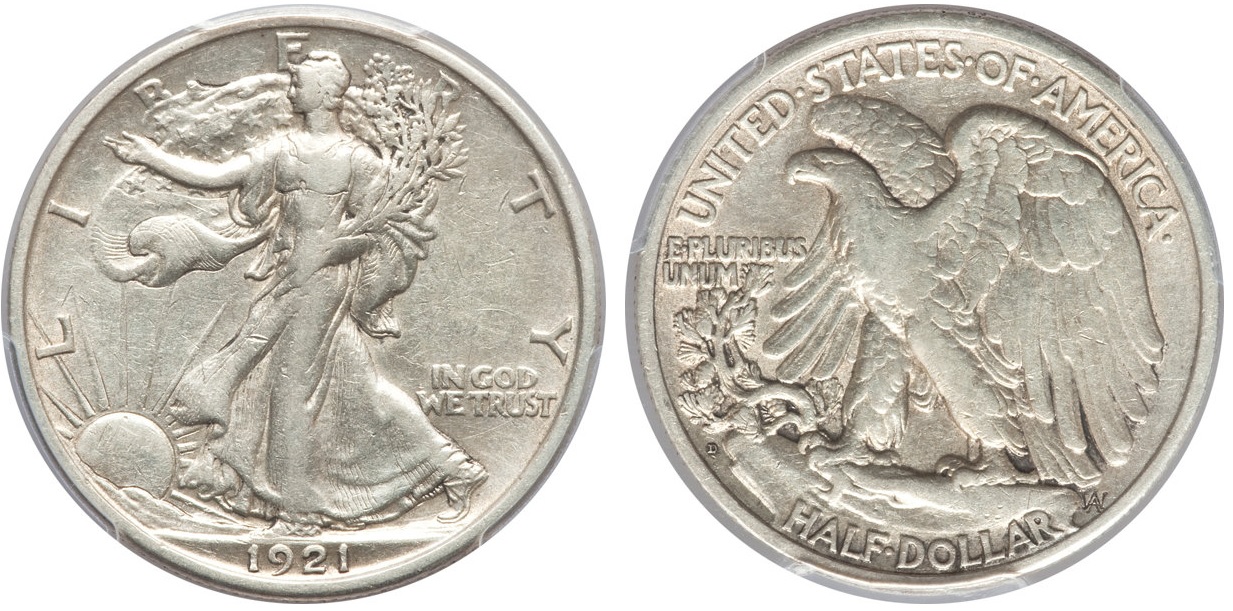
Franklin was honored by being placed on the half dollar from 1948-1963. His
portrait
still adorns the $100 bill.Image courtesy of
the the John H. MacMillan
collection. |
On September 17, 1787, all but three of the
remaining forty-two delegates signed their approval for the new Constitution.
In accordance with their belief in balancing competing interests against one
another, the delegates separated the national government's power into three
branches: The Executive [the Presidency], The Legislature [the
House and Senate], and The Judiciary [the courts]. A division of powers
was also provided for between the federal government and the states, both possessing
important areas of authority.
Furthermore, the federal government was granted
the muscle to tax and regulate commerce, to handle international affairs, and
the responsibility to provide for a national defense.
Article I, Section 8
enumerates Congressional powers, including the power "To coin money, regulate
the value thereof, and of foreign coin...". This gave Congress control
over the minting of money from metal and how much the coins shall be worth and
the clout to set the value of foreign money circulating in the United States.
Finally, the new Constitution specified a reasonable means of amendment, thereby
guaranteeing future generations of Americans could revise the document to meet
the changing conditions of their own times.
|
|
|
WE THE PEOPLE...the first three words of the
Constitution conveyed to a worldwide audience that in the newly created United
States, ultimate governmental power will be derived from the consent of the
people. Image courtesy of
National
Archives.
|
To indicate that the new federal government would
be a republic of Americans rather than just another confederation of states,
Pennsylvania delegate Gouverneur Morris rewrote the Constitution's Preamble with heart-stirring resolve: "We the
People of the United States, in order to form a more perfect Union, establish
Justice, insure domestic Tranquility, provide for the common defence, promote
the general Welfare, and secure the Blessings of Liberty to ourselves and our
Posterity, do ordain and establish this Constitution for the United States of
America."
The Constitution was sent to the Congress (still
assembling under the auspices of the Articles of Confederation), which in turn quickly sent it directly
to special ratifying conventions in the states for approval, purposely
circumventing the legislative bodies of the states. Many of the state
governments were dominated by individuals who would not be willing to relinquish
any powers at all, it was feared. Nine of
thirteen states had to approve the Constitution for it to go into effect.
|
 |
|
The Inauguration of George Washington, April 30,
1789, standing on the porch of Federal Hall on Wall Street in New York City, the
first capital city of the United States. As the final words of the oath
were spoken, the crowd erupted in cheers. From
an engraving by J. Rogers. Image courtesy of
Library of
Congress. |
On June 21, 1788, New Hampshire became the ninth
state to vote in favor of the proposal, and the Constitution was officially
adopted. Elections were held in January, 1789. The following April,
to no one's surprise, the first electoral college unanimously voted George
Washington as president, with John Adams chosen as vice president. Shortly
thereafter, the 1st Congress was seated.
In an age ruled by monarchs and tyrants, the
United States was about to embark on a representative government based on the consent of
the governed. The US Constitution was a remarkable and skillfully prepared
document, granting power from the
people to their own elected officials, an experiment in ordered liberty that has
withstood the test of time to this very day. |
Back to Top
|
The Bill of Rights |
|
 |
|
This 1966 postage stamp celebrates the 175th
anniversary of the Bill of Rights. The hand on the left, representing the
people, holds firm against the gloved fist of oppressive government,
thanks to the protection afforded by the Bill of Rights.
|
Despite the many individual liberty safeguards
written into the Constitution, some states would not ratify the document until
they were assured that a bill of rights, that is, a system of laws protecting
individuals against a potentially overbearing federal government, would be added
to the Constitution as the primary order of business of the 1st Congress.
As promised, the Congress quickly began
drafting a list of proposed amendments to the Constitution, to guarantee that
the rights of a person could not be suppressed by the power of government.
In September 1789, Congress voted in favor of
twelve amendments to the Constitution and sent them to the states for approval.
Two of them (addressing congressional salaries and redistricting) did not
survive the states' scrutiny, but the remaining ten were ratified and were
incorporated into the Constitution in 1791. The first ten amendments to
the Constitution became popularly known as the Bill of Rights.
The first eight amendments in the Bill of
Rights deal with personal freedom, property rights, and fair treatment under the
law. Amongst some of the guarantees enumerated are freedom of religion,
freedom of speech, and freedom of the press. The right of the people to
peacefully assemble, the right to petition government to correct wrongs, and the
right to keep and bear arms, are also precious liberties protected by the Bill
of Rights.
|
 |
|
James Madison, known as the "Father of the
Constitution" was also instrumental in drafting the Bill of Rights. This
five dollar gold commemorative coin, issued in 1993, honors Madison's
contributions.
|
As a further restraint against the police power
of the state, the Bill of Rights requires authorities to obtain a judge's
warrant before searching or confiscating any private property, and prohibits
"cruel and unusual punishment".
Individuals accused of crimes are to
receive a fair trial by jury and cannot be forced to testify against themselves.
The Ninth and Tenth amendments limit the powers of the United States government
to those specified in the Constitution. All other powers are reserved to
the states and to the people.
From the time of its ratification, the Bill of
Rights became one of the most cherished fabrics of American society. The
American people proudly consider it to be the trademark of our brand of freedom.
Globally, it has been the beacon of light that brought millions to our shores in
search of self-determination. In the United States, for example, if a
person stands on a street corner and criticizes government policy, the Bill of
Rights guarantees that person his right to free speech. Contrast this to
many other countries in the world, where anyone caught speaking ill of political
leaders would be thrown in prison, or worse yet, face a firing squad. No
wonder so many are willing to literally risk their lives to reside under our
Constitution and Bill of Rights.
For those of us who respect the accomplishments
of the Framers in writing our founding documents, David L. Hudson's
The Bill of
Rights: The First Ten Amendments to the Constitution provides a terrific
explanation of the full meaning of each amendment in the Bill of Rights.
Hudson goes into some detail (but not too much) into the thinking of the
Founding Fathers as the Bill of Rights were being drafted, and relates how this
is all important in our world today, through the use of highly illustrative
examples.
The book is written at a 6th grade level, but since Hudson's
enthusiastic approach makes it hard to put the book down, it is a great
inspiration for readers of all ages. When finished reading this book, you
will feel a deeper sense of appreciation for the wisdom of the Founders, and a
better understanding how individual liberties and rights have made this the
greatest nation in the history of mankind. |
Back to Top
|
References |
| 1 |
Allen, Jack, and John L.
Betts. History: USA.
New York, NY: American
Book Company, 1967. |
| 2 |
Breen, Walter.
Complete Encyclopedia of U.S. and Colonial Coins.
New York, NY: Doubleday Publishing, 1987. |
| 3 |
Brinkley,
Douglas.
History of the United States.
New York, NY: Penguin
Putnam, Inc., 1998. |
| 4 |
Doty,
Richard.
America's Money, America's Story.
Sydney, OH: Amos Press, Inc., 1998. |
| 5 |
Jordan,
Winthrop D., Miriam Greenblatt, & John S. Bowes. The Americans.
Evanstan, IL: McDougall, Littell & Company, 1988. |
Back to Top
|
©Copyright
2005 by us-coin-values.advisor.com. All rights reserved.
Use of any content contained on these website
pages without the expressed written consent of us-coin-values-advisor.com is
strictly prohibited.
No copyrighted images may be used without
permission of original copyright owner. |

|
|