|
| |
US Coin History
|
The Mint Branches Out
as the Nation Grows
|
|
|
The American people largely believed it was the Manifest Destiny of the
United States to expand westward. The siege of the Alamo, the Mexican
War, and the 49er Gold Rush were some of the most important defining
events. As the United States extended its boundaries, new branch
mints were established to serve the needs of the growing nation. |
|
Manifest Destiny |
|
 |
|
John Gast's American Progress depicts a
symbolic Liberty unrolling telegraph wire, as settlers head west. Indians can be
seen in retreat. Public domain image. |
From the earliest colonial times, rugged
pioneers had been drawn to the vast expanses of America's frontier.
Successive generations of settlers pushed the boundaries of the United States
ever more westward.
By 1820, most of the nation east of the Mississippi
River had been organized into states. Immediately to the west of the
Mississippi lay the fertile soil of the Great Plains, and beyond that, the
majestic Rockies, where a hardy breed of "Mountain Men" discovered trails and
passes that others would later travel.
To the far northwest beckoned the Oregon
Country, a prolific, heavily timbered land with easy access to bountiful fishing
waters. Looking to the south was Texas, a sparsely populated region of
unknown potential. And finally, on the coast of the mighty Pacific Ocean
was a far away place called California, blessed with some of the continent's
finest natural beauty.
|
 |
|
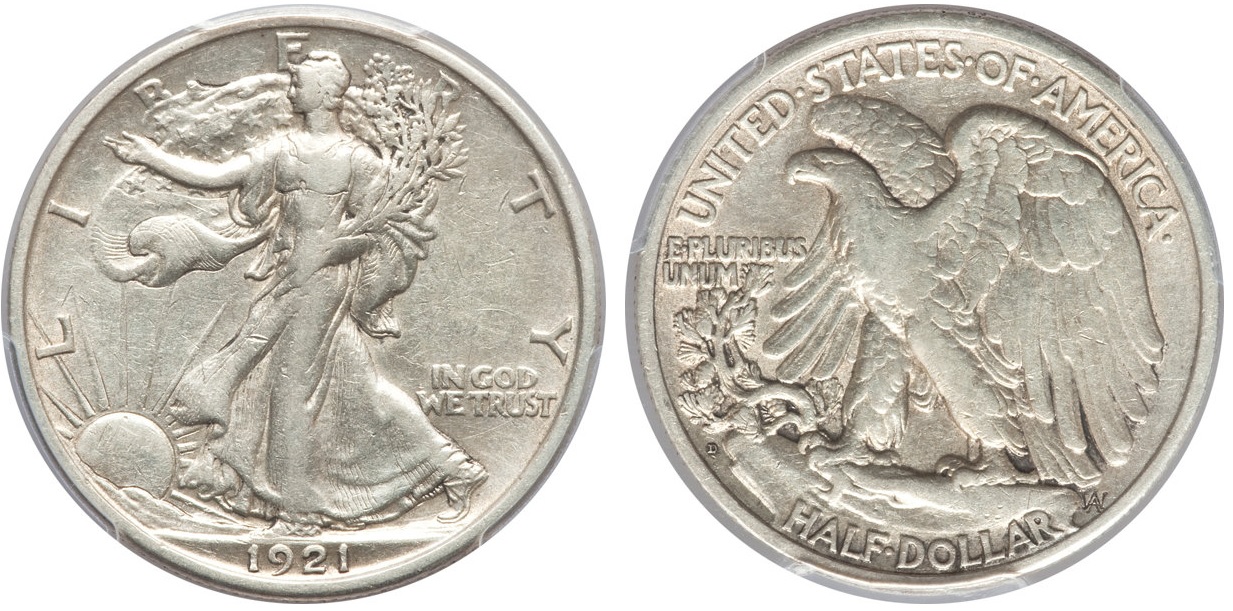
This commemorative half dollar was struck intermittently
from 1926 to 1939, to remember the historic 2000 mile Oregon Trail, which
brought thousands of settlers to the West.
Photo courtesy of Ira & Larry Goldberg
Coins & Collectibles, Inc., Beverly Hills, CA.
|
By the 1830's and 1840's, the desire to expand
westward intensified across all sectors of American society. Most people
came to believe it was the purpose of the United States, or its manifest
destiny, to own all the territory between the Atlantic and the Pacific.
Thus, "Manifest Destiny" became the guiding principle under which the West was
won.
As new states entered the Union, the triumphant
expansiveness of Manifest Destiny was pushed off center stage by an old divisive
issue taking on new proportions: the question of slavery. As we shall see
in the next chapter, the debate became so contentious that the nation eventually
ripped itself apart, resulting in a horrible civil war. |
Back to Top
|
Remember the Alamo! |
|
 |
|
Stephen F. Austin established large American
colonies in Texas and held key posts in the new Republic. Sam Houston
eulogized Austin as the "Father of Texas". Image courtesy of
Texas State Library and Archives Commission. |
In 1821, Mexico won independence for itself
from Spain. The new Mexican government, in a move to encourage development
of a thinly populated area we know today as southeastern Texas, offered land
grants to anyone, including Americans, who would be willing to inhabit the land.
In return, settlers promised to obey Mexican law and observe Roman Catholicism.
Among the first Americans to receive a land
grant was Moses Austin, originally of Connecticut, who planned to establish a
colony in Texas. Austin died before his dream could be fulfilled, so the
task of leading the people to Texas fell to his son, Stephen F. Austin. In
1823, the younger Austin led 300 families to the banks of the Brazos River,
where each family received about 200 acres of fertile farmland and more than
4000 acres of range land.
Under Austin's extraordinary organizational
skills, the colony prospered. Soon, many thousands of Americans flowed
into the territory, attracted by the rich farm soil and the generous land grant
policy of the Mexican government. Some settlers brought slaves and started
up cotton plantations.
By 1830, the number of Americans living in
Texas greatly outnumbered Mexicans, a fact that deeply concerned Mexican
authorities. In an attempt to curtail American influence in Texas, Mexico
closed the border to immigration from the United States, imposed taxes on the
importation of American goods, and restated that slavery on Mexican lands was prohibited. The Mexican government then sent troops into
the Texas province to enforce its laws.
|
 |
|
Davy Crockett fights off Mexican soldiers with
upraised rifle, in the final moments of the Alamo siege. Crockett and all
defenders of the Alamo perished, but Texas gained a new battle cry "Remember the
Alamo!", going on to win independence a few weeks later. Image courtesy
of Texas State Library and Archives
Commission. |
The Americans in Texas protested against what
they perceived to be a violation of their individual rights.
As tensions
escalated over the next several years, the Mexicans responded by sending more
troops. Finally, in 1835, violence broke out, prompting the Texans to
reject Mexican rule and declare their desire for self rule.
In late 1835, General Antonio Lopez de Santa
Anna, the latest in a series of Mexican military dictators, decided to crush the
rebellion. With an army of 6000 men, Santa Anna crossed the Rio Grande
headed north to take care of the Texans once and for all. On February 23,
1836, Santa Anna's army began a siege against 187 men garrisoned at a fortified
former mission called the Alamo, in San Antonio. Commanded by Lieutenant
Colonel William B. Travis, the brave defenders of the Alamo refused to
surrender, despite overwhelming odds. Serving under Travis in the Alamo
included a group of volunteers from Tennessee, led there by the famous
backwoodsman Davy Crockett. On March 6, the Mexicans stormed the
Alamo, finally scaling the walls and killing every last man inside, but at a cost to
Santa Anna of some 1600 troops.
While Santa Anna was preoccupied at the Alamo,
Texas formally declared its independence from Mexico on March 2. While the
heroic standoff at the Alamo continued, Sam Houston raised an army of Texans to
carry the fight onward.
Houston's forces surprised Santa Anna at San
Jacinto on April 21, 1836, shouting "Remember the Alamo!" as they swept through
the Mexican encampment. The Mexican general himself was taken prisoner,
but bargained for his release when he promised to recognize Texas independence.
Upon his return to Mexico, Santa Anna reneged on his pledge, but made no further
attempts to corral the feisty Texans. The Republic of Texas, also called
the Lone Star Republic, was born. Not surprisingly, Sam Houston was
elected as its first president.
During their revolution for independence,
American sympathy was with the Texans, but when the new republic petitioned for
statehood, strong opposition arose. Texas permitted slavery, causing
members of Congress from northern states to argue against the admission of
another southern slaveholding state. Others feared that Mexico would be
provoked into war if Texas joined the Union. For these reasons, statehood
for Texas was delayed.
|
 |
|
This commemorative coin celebrated the 100th
anniversary of Texas Independence. Minted between 1934 and 1938, the
obverse features a Lone Star behind the eagle. The reverse depicts a
winged Liberty cradling the Alamo, birthplace of Texas. Flanking Liberty are
portraits of Sam Houston and Stephen F. Austin.
Photo courtesy of Ira & Larry Goldberg
Coins & Collectibles, Inc., Beverly Hills, CA. |
As the election of 1844 approached, the
annexation of Texas became a major campaign issue. The Democrats rejected
Martin Van Buren, a former president and member of their own party, in favor of
James K. Polk of Tennessee, who strongly favored statehood for Texas and
westward expansion. When the electoral college votes were counted, Polk
easily outpaced Henry Clay of Kentucky. A majority of congressional
candidates supporting expansion won likewise, a clear signal the public
supported Texas annexation in particular and Manifest Destiny in general.
With the mandate sent by the voters,
outgoing President John Tyler moved quickly to push a statehood resolution for
Texas through both houses of Congress, ending the controversy over the fate of
the Lone Star Republic. Finally, on December 29, 1845, Texas entered the
Union as the twenty-eighth state. |
Back to Top
|
The Mint Branches Out |
|
When the Philadelphia Mint began regular
production in 1793, it was thought at the time that this facility would fulfill
the coinage demands of our new nation. Within forty years, however, pioneers had
extended the boundaries of the American frontier so distant from Philadelphia
that the Mint could not viably serve the entire nation any longer.
In
order to meet the needs of the growing country, several branch mints were
opened, the first ones striking coins in 1838, located in
Dahlonega, GA,
Charlotte, NC, and
New
Orleans, LA. To distinguish the place of origin, small letters, or "mint
marks", were included in the coin's design, differentiating one mint from another.
We have a
Saga of the US Mint section that goes into greater detail
on the various mints that have ever seen service in this country. You can
learn more about our US Mints and see images by clicking
here.
Most people think the first gold rush in US
history happened in California, but actually, it took place in North Carolina
and Georgia decades earlier. For the hard core coin collector historian type, we suggest
obtaining a copy of
Neighborhood Mint: Dahlonega in the Age of Jackson. The details of the
creation of the Dahlonega Mint are described in amazing detail. The
Dahlonega Mint never did produce the quantity of coins originally envisioned,
meaning that some of the coins of this branch mint are amongst the rarest in
American numismatics. A fascinating story, the Dahlonega Mint continued in
operation until the earliest days of the Civil War. |
Back to Top
|
War With Mexico |
|
Not everyone was as enthused over the idea of
Manifest Destiny as were the Americans. Still seething over the loss of
Texas, Mexican authorities were concerned over the possibility of giving up the
vast region west of Texas, including California, to the United States.
These and other factors led to a war between the United States and Mexico,
finally breaking out in 1846.
|
 |
|
The influence of Spanish culture was evident
throughout California and the southwest. A Spanish mission is shown above.
Image courtesy of
Library of Congress. |
Mexico's claim on California and the southwest
was inherited from the Spaniards, dating back to the 15th century. Spanish
law, architecture, culture, and language prevailed throughout the area.
However, Mexico's grip on the territory was weak at best, in large part due to
sparsely populated regions, poor administration and a revolving door of corrupt government officials.
In 1845, tensions between the United States and
Mexico mounted as the dispute over the southern boundary of Texas magnified.
The Mexican government asserted the boundary between Texas and Mexico was the
Nueces River, while the Americans maintained that it was the Rio Grande River,
about a hundred miles to the south of the Nueces, that separated the two nations.
|
 |
|
James K. Polk is rated as one of the most
effective presidents in US history, who met the demands of office with
perseverance and great administrative skill. Under his watch, the US
expanded all the way to the Pacific Ocean. The only president ever to
achieve all of his platform goals, Polk declined to run for a second term.
Three months after leaving the White House, the Tennessean was dead.
Image courtesy by the
National Archives.
|
When it appeared the Mexicans were willing to
negotiate the dispute peacefully, President Polk secretly dispatched congressman
John Slidell to Mexico City in November 1845, with instructions to pay off
claims of about $2 million by American citizens against Mexico, if Mexico would
acknowledge the Rio Grande as the southern boundary of Texas. Furthermore,
Polk authorized an offer of $25 million for the purchase of California and $5
million for the New Mexico territory.
When news of Slidell's mission was leaked, the
Mexican populace was incensed over what they perceived as yet another American
expansionist scheme at the expense of Mexico.
Meanwhile, the Mexican
government refused to speak with the American envoy, sending him home
empty-handed. Mexican newspapers ridiculed American diplomacy and military
prowess and called for a "necessary" war against the United States.
Mexican army leaders bragged they could defeat their northern neighbor in a
military confrontation, based on their experience at expelling the Spaniards and
putting down internal revolutionists. They also assumed Great Britain
would come to their aid, because the British had opposed the United States'
annexation of Texas. They also believed American public opinion would be
sharply divided over support of a war. Clearly, Mexico was itching for a
fight.
|
 |
|
News of the Mexican War hits the home front, as shown in this
engraving based on the 1848 painting by R.C. Woodville. Image courtesy
of Humanities-Interactive.
|
In January 1846, President Polk ordered troops
under General Zachary Taylor to cross the Nueces River, southward into the
disputed zone, to the northern bank of the Rio Grande. In May, Mexican troops
crossed the Rio Grande and skirmished with American forces, killing or wounding
sixteen. If Polk had been waiting for an excuse to ask Congress for a
declaration of war against Mexico, he now had it. On May 13, Congress
obliged. War with Mexico was on.
It soon became apparent that Mexico's boast of
military superiority was premature. Even though the Mexican army was four
times the size of the American army, the natural resources and industrial might
of the United States enabled its troops to be better equipped and supplied.
Many reservists were quickly called into active duty to rectify the initial
imbalance of manpower. They were all trained and led by competent
graduates of the national military academy at West Point. In addition, the
small, but well organized American navy was capable of ferrying troops to within
250 miles of Mexico City. With these advantages, American military
strategists were able to devise a war plan consisting of three fronts that
effectively subdued the Mexicans.
The first front was to commence from the Rio
Grande, where General Taylor's army sat primed to go. Taylor became a
national hero following his victory at Buena Vista, giving control of northern
Mexico to the Americans. Another group of Americans, led by General
Stephen Kearny, marched from Fort Leavenworth, Kansas, to Santa Fe, taking
possession of the New Mexico territory. From there, Kearny proceeded to
California and joined with Captain John C. Frémont (who had established
temporarily the Republic of California, a.k.a. the Bear Flag Republic) and other
American forces, to completely overcome Mexican resistance in California.
|
 |
|
General Winfield Scott (center, on brown horse
facing right) parades the US army in Mexico City's main square. To the
right of the cathedral is the National Palace, built atop the ruins of the Halls
of Montezuma. Image courtesy
of University of Texas at Arlington
Libraries. |
A third expedition, under the command of General Winfield Scott, hit Vera Cruz
following an amphibious landing in March 1847 of 14,000 men from the Gulf of
Mexico.
From there, the Americans embarked on a tortuous journey toward
Mexico City, following the route traveled by Hernando Cortez centuries earlier.
Nearly every step of the uphill, mountainous road leading to the "Halls of
Montezuma" was bitterly challenged. Several difficult battles were fought
along the way, but Scott continued to advance. After the fall of
Chapultepec, the last major line of Mexican defense, American troops entered Mexico City as conquerors
on September 14, 1847. For all practical purposes,
the Mexican War had come to an end.
|
 |
|
The map of the United States in 1848,
following Mexican War. The pink to the left is the region ceded by Mexico.
The blue in the upper left is the Oregon Country. The middle green is the
state of Texas, while large yellow area is remainder of Louisiana Purchase yet
to be organized into states. Image courtesy of
Humanities-Interactive.
|
The Treaty of Guadalupe Hidalgo, signed on
February 2, 1848, formally ended the war. Mexico was forced to give up
California, the New Mexico territory, and recognize the Rio Grande as the border
between Texas and Mexico.
In return, the United States paid Mexico $15
million and agreed to assume debts totaling over $3 million that Mexico owed to
American citizens. From the "Mexican Cession" ultimately shaped the states
of California, Nevada, and Utah, and parts of Arizona, New Mexico, Colorado, and
Wyoming.
In 1853, Congress approved a payment of $10
million to Mexico for the purchase of some 50,000 square miles of desolation
along the southern tip of what is today Arizona and New Mexico. The
Gadsden Purchase, as it was called, was thought to be suitable for a southern
transcontinental railroad being contemplated. Except for Alaska, the
Gadsden Purchase filled out the present continental boundaries of the United
States.
The dreams of all Americans who had believed in
their nation's Manifest Destiny had materialized. The boundaries of the
United States now reached from sea to shining sea. |
Back to Top
|
The California Gold Rush and
the San Francisco Mint |
|
By 1848, only a few hundred Americans had settled
in California. One of them was a man named John Sutter, a European
immigrant who set up a successful sawmill in the Sacramento Valley.
On January 24, 1848,
ten days prior to the acquisition of California by the United States from
Mexico, as specified by the Treaty of Guadalupe Hidalgo, one of Sutter's
employees, James W. Marshall, noticed a shiny substance in a stream where he was
building a sawmill. Tests later proved it was gold!
Word of the discovery spread around the world like wildfire.
Within a year, many thousands of "49ers" were attracted to
California in search of gold, greatly
accelerating the settlement of the California and the West.
By the end of 1849, California's population had
grown more than enough to apply for statehood. When California's
application to enter the Union as a free state reached Washington, a crisis
erupted. If California entered the Union as a free state, the existing
balance of 15 slave and 15 free states would be upset in favor of the North.
Under the terms of the Compromise of 1850, California was eventually admitted as
a free state (see more about this in the next chapter).
|
 |
|
The 1848 "CAL." quarter eagle, minted in
Philadelphia from California gold. A great rarity of historical
significance, the specimen above is valued in excess of $50,000.
Photo courtesy of Ira & Larry Goldberg
Coins & Collectibles, Inc., Beverly Hills, CA.
|
Some of the gold from the fabulous strike was sent
in a special shipment to Philadelphia. The letters "CAL." were
counterstamped by mint officials on the reverse side of 1,389 quarter eagles
bearing the 1848 date to show that they were coined out of gold originating from
the California gold fields. These "CAL." quarter eagles are unmistakable
links to one of the most significant events in American history, are quite rare
and have been highly valued by generations of coin collectors.
The impact of the California Gold Rush cannot be
overstated. The massive influx of gold bullion upset the old ratio between gold
and silver, triggering a monetary instability that would last until until gold
and silver were finally removed from coinage, gold in 1933 and silver in 1965.
As we saw a couple of paragraphs above, and shall see
in more detail in the next
chapter, the gold discovery also renewed the rivalry between the North and South.
Indeed, it can be argued that the California Gold Rush was one of the events
leading to the American Civil War.
|
 |
|
One of the very few images of the original
San Francisco Mint, seeing service from 1854 to 1873. Image courtesy of Gary
Nabors.
|
By 1852, the California gold fields had yielded
millions in gold, yet there was a severe shortage of coins to serve the
Wild West population. The deficiency of circulating coinage, the availability of
a bullion supply, and California
statehood encouraged Congress to authorize a
branch mint at San Francisco, with
the doors first opening in
1854. After getting off to a slow start due to the lack of chemicals
needed for refining gold, the new San Francisco Mint started converting the
miners' gold into adequate coin supplies about three years after its debut.
Prior to the start-up of the new mint, and
then for a while thereafter, the coinage
needs of the population were partially being met by private, state, and
territorial minters. Today, quite a few collectors are fascinated by these "pre-mint"
California gold issues, and actively collect them. Moffat & Company,
Templeton Reid, and Norris, Greig & Norris were some of the private companies
issuing coins from 49er gold. Moffat & Company in particular manufactured
enough coins to at least make a dent in the miners' need for coins.
|
 |
|
A 49er pans for gold in the American River, Fortune seekers
quickly swelled California's population, bringing statehood in 1850, and a new
mint to San Francisco in 1854. Public domain
photo.
|
The California Gold Rush was a rare,
astonishing event, dividing American history into a "Before" and "After".
It was one of the biggest mass movements of humanity since the beginning of
time, and played a large role in shaping the future of the United States.
An excellent portrayal of the gold migration is
The Age of Gold: The California Gold Rush and the New American Dream by H.W.
Brands. Even if you're not a student of history, you will enjoy this book.
Brands describes the hardships, at times horrifying, that many people faced as
they traveled westward in search of riches.
The narrative is cast in a delightful
story-telling mode, backed up by intelligent analysis and historical fact.
Most of the 49ers realized they would not become wealthy in their quest, but
the "Dream" and the entrepreneurial spirit prevailed, setting the success
template for a long time to come.
Furthermore, Brands chronicles numerous accounts of the
people who lived the experience, from John Fremont and Leland Stanford, to those
much less famous. He concludes by describing why these stories have a national
and international significance.
The Age of Gold: The California Gold Rush and
the New American Dream is a glittering epic, having great appeal to fans of
American history, or simply anyone looking for an entertaining read. |
Back to Top
|
New American Coin
Denominations |
|
Two additional regular gold denominations were
issued beginning in 1849: the gold dollar and the double eagle (face value = $20.00). The 1849 double eagle is a one of a kind specimen, on display in
the numismatic collection of the Smithsonian Institute. Starting in 1850, double eagles were minted in quantities large enough for general
circulation.
|
 |
|
The silver three cent piece, also known as the "trime".
Image courtesy of Jake's Marketplace.
|
In 1851, responding to the new three cent postage rate, the three
cent silver "trime" was authorized. Notably, the trime had a silver
bullion value worth only 86% of its face value, a measure designed to discourage
coin melting. This was the first incident where a minted coin's face value
was greater than its intrinsic metallic value.
Silver three cent pieces were not
widely accepted by the public. Mintage totals dwindled rapidly after the
first three years, finally
discontinued beyond 1873. Equally disliked was the three cent copper-nickel
coin, minted from 1865-1889.
|
Back to Top
|
References |
| 1 |
Allen, Jack, and John L.
Betts. History: USA.
New York, NY: American
Book Company, 1967. |
| 2 |
Brinkley, Douglas.
History of the United States.
New York, NY: Penguin
Putnam, Inc., 1998. |
| 3 |
Doty,
Richard.
America's Money, America's Story.
Sydney, OH: Amos Press, Inc., 1998. |
| 4 |
Jordan, Winthrop D., Miriam Greenblatt,
& John S. Bowes.
The Americans.
Evanstan, IL: McDougall, Littell & Company, 1988. |
| 5 |
Schwarz, Ted.
A
History of United States Coinage.
London, England: A.S. Barnes & Company, Inc. 1980. |
Back to Top
|
©Copyright
2005 by us-coin-values.advisor.com. All rights reserved.
Use of any content contained on these website
pages without the expressed written consent of us-coin-values-advisor.com is
strictly prohibited.
No copyrighted images may be used without
permission of original copyright owner.
|

|
|