|
| |
New Orleans Mint Coins
|
The New Orleans Mint
|
|
Date of Service:
1838 to
1861 and 1879-1909
Mint Mark:
"O"
|
|
|
The New Orleans Mint opened for business in
1838, amid political strife. The venerable facility subsequently
experienced war, peace, neglect,
modern rebirth, and Hurricane Katrina. Read on to learn more about
the New Orleans Mint and its unique role in the history of the Crescent
City.
|
|
Jackson vs. Biddle, New Branch
Mints, and the Panic of 1837 |
|
 |
|
The introduction of commercially successful
steamboats in the early 1800s increased commercial traffic on the Mississippi
River, elevating the importance of the city of New Orleans. Image courtesy of
Library of Congress. |
The introduction of reliable
steam-powered paddleboats in the early 1800s helped make New Orleans one of the
busiest port cities in the United States. Steamboat traffic on the
Mississippi River floated American goods bound for worldwide distribution to New
Orleans, for access to the high seas.
As a port of entry, New Orleans
played a major role receiving foreign imports, including gold and silver from Mexico, and
was a critical link to the western frontier. By 1830, "The Crescent
City" was
one of the largest American cities and a focal point in the nation's economy.
The
Philadelphia Mint was producing coins at full capacity, but was still not
capable of supplying the coinage needed for westward expansion, due in large
part to the great distance separating the "City of Brotherly Love" from the
farthest reaches of the American South and West. President
Andrew Jackson, the hero of the
Battle of New Orleans
during the War of 1812, persuaded Congress that establishing a branch mint in
New Orleans would increase coinage circulation in the more remote regions of the
nation and stimulate economic activity and growth.
|
 |
|
The Second Bank of the United States in
Philadelphia, designed by
William Strickland, built in 1819. At one time, the Second Bank was the
financial center of the United States, and the source of great political
controversy. This photo taken in 1959. Image courtesy of
Library of Congress. |
Jackson also viewed a mint in
New Orleans as another weapon in his bitter crusade against Nicholas Biddle and
the powerful Second Bank of the United States, located
a very short distance from the Philadelphia
Mint.
Jackson disliked the Second Bank because he saw it as
a banking
monopoly set up by the "rich and powerful" to benefit the wealthy few living in
eastern seaboard states, locking out financial opportunities for those living in
the Appalachians and points further west.
Jackson also claimed the
existence of the Bank to be unconstitutional. In staking this position, he
expressed his belief in the limited powers of the federal government, but at the
same time was ignoring the 1819 Supreme Court ruling that the Bank was
acceptable under the Constitution. Distant branch mints would generate hard currency far outside Biddle's orb of
influence, weakening the Second Bank while strengthening the hand of state
banks and common citizens, or so the Jacksonians averred.
On March 3, 1835, the
President
signed into law the Act authorizing the construction of the New Orleans Mint.
The same Act included text to create additional branch mints at
Charlotte, North
Carolina, and
Dahlonega, Georgia. Of these three new mint outposts, it
turns it that it was the New Orleans facility destined to have the longest, most
colorful history.
|
 |
|
Andrew Jackson (l), President of the US, faced
off against Nicholas Biddle (r), President of the Second Bank of the US, in the
greatest political battle of the Jacksonian Era. Jackson prevailed, but in
doing so, inadvertently sowed the seeds of the Panic of 1837. Images
courtesy of National Archives and
Library of Congress. |
Some historians view the
origin of the New Orleans Mint as little more than a pawn in the tale of Jackson
vs. Biddle. Eventually, Jackson succeeded in destroying the Second Bank of the United
States. The Bank's federal charter was not renewed upon its expiration in
1836.
However, several years before the Bank was to die a natural death,
Jackson hoped to speed the process along by withdrawing gold and silver from the
Bank and depositing it into smaller banks out West. This move triggered a
series of unintended consequences that proved disastrous to America's
financial health. With federal money as security, many of Jackson's "pet
banks" issued their own paper notes, whose cumulative face value far exceeded
the worth of the precious metals they had on deposit. This "easy money"
was often leveraged by ordinary people to speculate in land purchases from the
United States government. By 1836, the US Treasury was awash in this
unsound currency.
Jackson acted to counter the
wild land speculation by issuing an Executive Order called the "Specie Circular"
(specie
is another word for gold and silver coinage). The order mandated the Treasury not
to accept anything other than specie (or notes backed by same) for the sale of
federally owned lands. Soon thereafter, serious trouble began. The
sale of public property dried up because the gold and silver coins required to
consummate transactions were scarce, especially in the hinterlands where much of
the land was for sale. Clients flocked to their banks, clamoring for redemption
of their unsecured
notes in gold and silver coins. Of course, banks that over issued their
notes could not honor the exchange demand, and as a result, had no choice but to
declare insolvency and close their doors.
|
 |
|
The Panic of 1837 caused men to stand idle, and
women and children to beg for food. The government demanded gold and
silver coins for payments, which few people could do because banks had suspended
specie exchanges. The Whig Party made large political gains as a result of the
economic malaise, at the expense of the Democrats. Public domain image. |
By early 1837, every bank in
the United States was forced to suspend specie payments. A great panic
ensued, causing hundreds more banks to fail, wiping out depositors' savings and
taking down thousands of businesses and jobs. Factories closed.
Construction work on buildings and roads came to a standstill. Hungry
unemployed wage earners rioted in the streets of major cities. The new
President, Martin Van Buren, had hardly settled into the White House before
being confronted by all this massive financial chaos. The Panic of 1837
dragged on into the 1840s, and to a great extent, crippled the Van Buren
administration.
Sadly, what started out as an
earnest attempt to help the common man gain better footing against privileged
business interests, indirectly led to the worst economic depression in American
history, up to that point in time. |
Back to Top
|
The First New Orleans Mint Coins |
|
 |
|
Two of Strickland's original four 1835 drawings
of the proposed New Orleans Mint. The front and side elevations (top), and
the first floor layout (bottom) are shown. Image courtesy of
Library of Congress. |
William Strickland, the
famous architect who designed the
Second Philadelphia Mint, the
Second Bank of
the United States, as well as the
Charlotte and
Dahlonega Mints, was also
commissioned to draft plans for the New Orleans facility. Strickland's
Greek Revival style was clearly evident in the drawings and specifications for
the fortress-like structure he provided to the government.
The 1835
law authorizing the creation of the nation's first three branch mints allocated
a sum of $50,000 to cover construction costs for each of the Charlotte and
Dahlonega Mints. A total of $250,000 was set aside to build the New
Orleans Mint, so it was obvious from the outset that Treasury officials intended
for the three-story edifice to be one of the most dignified architectural
accomplishments in the entire South upon its completion.
Construction commenced in
September, 1835. By the time it was finished, the overall length of the
building was 282 feet, having a center section measuring about 90 feet in length
and 107 feet in depth, graced by a columned entrance. The center
section was flanked by two "L-shaped" wings, dimensioning approximately 96 feet
in length by 81 feet at the bottom of the "L" (i.e. the sides of the building).
The stem of each "L" connecting into the center section was built to about 45
feet in depth.
In 1837, coining presses and
other minting machinery were shipped to New Orleans from Philadelphia. The
next year, May 1838 to be precise, the first New Orleans Mint coins were struck,
bearing the characteristic "O" mintmark. A total of 30 dimes were struck
the first day. Less than $500,000 face value was coined in 1838, most of
it gold. In fact, the first several years of production saw relatively
small mintages because the equipment from Philadelphia was all manually powered.
In 1845, steam-powered
machinery was introduced. Some of the gold recovered from the
California
Gold Strike of 1848 made its way by ship to New Orleans, substantially
increasing the Mint's output. By 1851, the Mint's production capability
kicked into high gear, striking more than $10 million in coinage. In
between a spate of structural repairs during this time (the building's
foundation and supports were not well suited for southern Louisiana), the
facility soldiered on with its coinage mission. It was, however, the next
chapter of the New Orleans Mint ordeal that earned it a tumultuous standing in the
annals of history. |
Back to Top
|
Turbulent Times During the War
Between the States |
|
The Louisiana Secession
Convention voted on January 26, 1861 in favor of separating from the United
States. Less than a week later, the State of Louisiana took possession of
the New Orleans Mint. Before control changed hands, 330,000 half dollars
bearing the 1861-O date were struck by the hand of the US government. In
February, the same mint personnel, now loyal to rebellious Louisiana, produced
1,240,000 of the 1861-O half dollars by the authority of the state.
After joining the Confederate States of America, Louisiana turned the Mint over
to the Southern cause. Minting of the half dollars continued, with another
962,633 struck under the auspices of the Confederacy.
|
 |
|
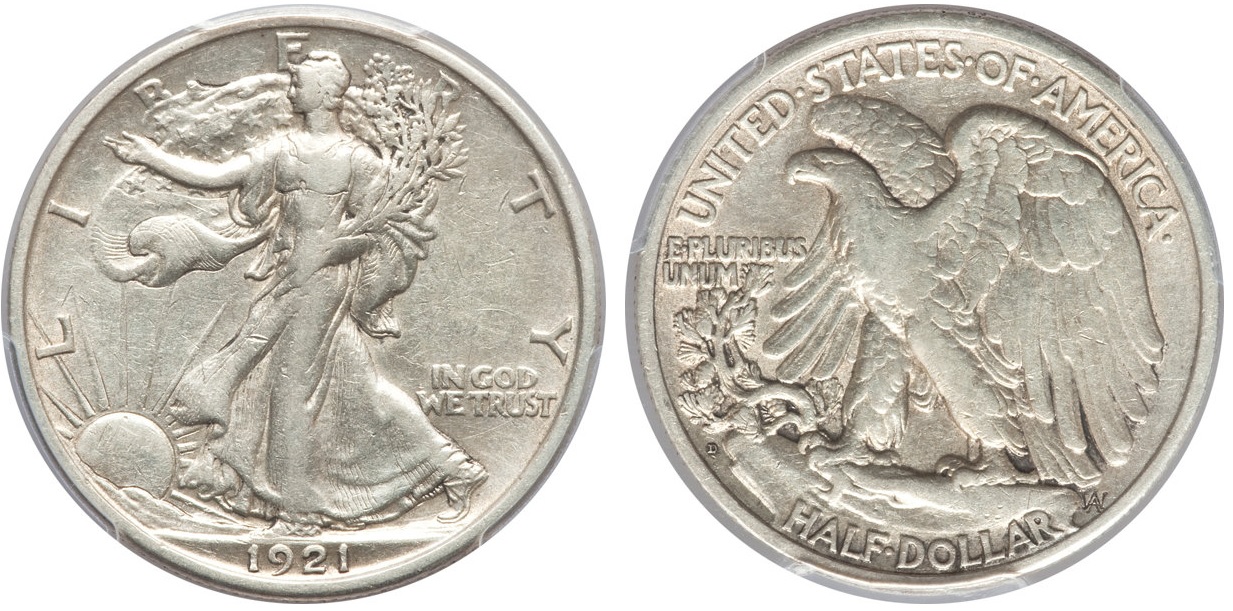
Who knows under whose authority the 1861-O half
dollar pictured above was struck? Since the same dies were used throughout
all of 1861, it is impossible to know if this was issued by the US, the State of
Louisiana, or the Confederate States of America. |
In all,
2,532,633 half dollars were minted in New Orleans in 1861, all carrying the "O"
mintmark. Unfortunately for numismatists, it is impossible to determine
which coins were struck by what governmental entity, since all the dies utilized
were of the same federal design. 17,741 gold double eagles were also
issued at the New Orleans Mint during this time, but as with the half
dollars, it is not possible to know exactly when and and under whose authority they were struck.
The New Orleans Mint, renamed by its new owners as the Confederate State Mint,
was the only southern mint to produce authentic coinage bearing designs symbolic
of the Confederate States of America. It was the desire of CSA president
Jefferson Davis and other Confederate leaders to strike coins in the name of the
Confederacy, in the hopes of winning international recognition as a sovereign
nation. Confederate coinage is indeed quite fascinating, as are other
coins from those turbulent years. For this reason, we've written another
chapter, Money of the Civil War, that describes in greater detail, including
images, the story of how Confederate coinage came into being, and the events
leading to its premature demise.
Mint
operations were formally halted on April 30, 1861, thanks to less than ample
bullion supplies, and other considerations. On May 31, the remaining mint
staff was ordered to vacate the premises, whereupon Confederate soldiers took up
residence. The steam-powered
coining machinery was transferred to other southern factories and converted over
to the war effort.
|
 |
|
General Benjamin Butler of the Union army, the
man sentenced by Confederate President Jefferson Davis to be executed instantly, if
captured. Davis was retaliating for Butler's order to hang a southern
sympathizer from a New Orleans Mint flagstaff. Image courtesy of
Library of Congress. |
In April,
1862, the city of New Orleans fell to a Union naval force commanded by Captain
David Farragut. The Mint's remaining bullion supply was safely whisked
away just in time to
Dahlonega to avoid Union capture. The Yankees promptly selected
the old Mint as their headquarters, and raised the United States flag to fly
atop the building.
To see Old Glory proudly waving over one of the South's
finest cities was too much of an insult to endure for a few of the locals. William Mumford, a New Orleans riverboat gambler who drank heavily, removed the
flag and defiantly desecrated it publicly. He was arrested and
hanged from a flagstaff projecting from one of the windows under the front
portico of the center section, by the order of U.S. Army General Benjamin
Butler, on June 7, 1862. This incident at the Mint was one of the most
notorious events of the Civil War, prompting CSA President Jefferson Davis to
proclaim Butler a "felon" and to issue the extraordinary decree that if the
general was ever taken captive, he was to be executed immediately. |
Back to Top
|
A Second Life for the New Orleans
Mint |
|
Throughout most of the
Reconstruction Era, the New Orleans Mint building sat empty. In October,
1876, the Mint reopened as an assay office. The following year, Treasury
officials began to seriously contemplate the feasibility of restoring the
facility to full mint status.
|
 |
|
This photo taken between 1880 and 1901, during
the second life of the New Orleans Mint. Image courtesy of
Library of Congress. |
After making repairs and
installing new machinery, the New Orleans Mint resumed coin production in 1879.
Of the three southern mints, it was the only one to reopen following the Civil
War.
For the next 30 years, New Orleans continued to strike gold and
silver coins, but as time marched on, it became increasingly clear the "O" Mint
was nearing the end of its heyday. Newer equipment in the Denver and San
Francisco Mints dwarfed the productivity of the aging New Orleans facility,
raising many questions about its future viability. In 1909, in its 71st
year of existence, the New Orleans Mint released the last of its $298,660,707
lifetime coinage production. Two years later, the historic structure was
stripped of much of its machinery and relegated once again to an assay office. |
Back to Top
|
An Urban Eyesore Becomes a
National Historic Landmark |
|
 |
|
This 1963 photo, taken on the second floor of the
New Orleans Mint, illustrates the effect of neglect and decay on the historic
structure. Image courtesy of Library of
Congress. |
The mint building remained an
assay office until 1931, when it was transformed into a federal prison.
Perhaps some Washington bureaucrats were impressed by the imposing
structure's potential as an incarceration center. The building functioned
in this capacity until 1943, when the Coast Guard took over and used it as a
receiving station. For the next two decades plus, the building was
neglected and fell into a sad state of disrepair, a real eyesore and token image
of urban blight.
In 1966, possession of the
building was transferred from the federal government to the State of Louisiana
free of charge, with the provision that it be restored within 10 years.
Under the direction of the Louisiana State Museum, a number of community groups
successfully raised the funds necessary to renovate the old Mint, though most of
the work occurred beyond the ten year time frame. In 1981,
the Mint was opened to the public as a museum, dedicated to building's original
purpose and to Louisiana history. In November 2002, the museum greatly expanded to
occupy the entire open area of the first floor.
Today, the old New Orleans
Mint remains safely registered as a National Historic Landmark. It is the nation's
oldest unreconstructed mint in its original location, and is one of five sites
operated in the city's French Quarter by the Louisiana State Museum.
Thousands of visitors from all over the globe are welcomed here annually.
Once inside, they will find artifacts of yesteryear's minting processes, including
coining presses, weighing machines, and assay balances. Numismatists
will take delight in a large coin dealership that specializes, naturally, in New
Orleans Mint coins. A virtually complete collection of "O" mintmarked
silver coins is on view for all to see and enjoy.
|
 |
|
The New Orleans Mint as it appears today.
Constructed during the 1830s, it is actually one of the newest buildings in the
historic French Quarter district, on Esplanade Avenue. Image courtesy of
Louisiana State Museum. |
The museum
complements the landmark's coin factory image by going to great lengths to
chronicle the human side of a few of the characters who once walked these very
same hallways, some of whom actually lived within the Mint's confines during
their tenure of employment in New Orleans.
Explorers venturing to the
second floor will discover the old Mint also plays host to a New Orleans Jazz
display, chocked full of memorabilia celebrating the rise of jazz from its humble street
origins to worldwide acclaim. On the third floor is the Historical Center,
an archive specializing in maps and documents of the early French and colonial
periods, and other aspects of Louisiana's past.
During its storied, sometimes
raucous existence, the New Orleans Mint has served many purposes: coining
facility, military headquarters, assay office, federal prison, warehouse, and
museum. Certainly, there must have been occasions where razing the old
building was a temptation. Thank goodness Andrew Jackson's sponsored
project survived the wrecking ball mentality, and now, in our modern age, is a vibrant link
to America's numismatic and historical legacy. |
Back to Top
|
Hurricane Katrina
Strikes the New Orleans Mint |
|
One of the most unforgettable
days in recent history occurred August 29, 2005, as Hurricane Katrina ravaged
the city of New Orleans and much of the Gulf Coast. In its wake, Katrina
left massive destruction, flooding, and death. For many days, news
headlines documented the storm's fury and the human misery it caused.
The historic New Orleans Mint
building did not escape Katrina, but the situation could have been worse. The floodwaters that engulfed most of the city stayed clear of the
Mint building and the French Quarter district in general. Within two days
after Katrina hit, the Louisiana State Museum staff re-entered the building
under armed escort. Structural damage was limited to a large piece of the copper roof blown
off, causing some water damage in office areas below. Miraculously, no one
attempted to break into the unattended building, leaving the artifacts inside,
including rare coins, intact.
The museum staff worked with government officials to repair the Mint roof and water damage.
More than two years were required to complete the restoration. While the
museum was closed, the numismatic
collection and other historical exhibits were stored at an undisclosed location.
The museum reopened in October 2007. We have a section describing in fuller detail, the activities at
the
New Orleans Mint after Katrina.
|
Back to Top
|
References |
| 1 |
Brinkley,
Douglas.
History of the United States.
New York, NY: Penguin
Putnam, Inc., 1998.
|
| 2 |
Jordan, Winthrop D., Miriam Greenblatt,
& John S. Bowes.
The Americans.
Evanstan, IL: McDougall, Littell & Company, 1988. |
| 3 |
Lambousy, Greg. "The Mint in New
Orleans."
The Numismatist 116
(March 2003) pp. 36-43. |
| 4 |
von Klinger, Eric. "Louisiana Expands
Displays at New Orleans Mint Museum." Coin World,
July 29, 2002, pg 1. |
| 5 |
von Klinger, Eric. "Minting in the Old
South on View."
Coin World,
December 9, 2002, pg 3. |
| 6 |
von Klinger, Eric. "New Orleans Mint
Serves Multiple Purposes."
Coin World,
December 9, 2002, pg 3. |
Back to Top
|
©Copyright
2008 by us-coin-values.advisor.com. All rights reserved.
Use of any content contained on these website
pages without the expressed written consent of us-coin-values-advisor.com is
strictly prohibited.
No copyrighted images may be used without
permission of original copyright owner. |
|
|