Get unbiased advice here on coin buying.
Routines and guidelines are covered, including coin dealers, coin
auctions, coin shows, buying coins on the Internet, and more. Make
good coin buying decisions to enhance your coin collecting experience.
Pretty soon, we'll be covering
options for buying coins, but first, let’s touch upon some basic guidelines
to keep in mind as you embark on your coin buying career.
Think Long
Term. Don’t buy a coin today and expect to
resell at a profit six months from now. Remember, if you’re buying and selling through dealers, you’ll pay
retail and sell at wholesale. Even
the most bullish of US coins
may take a few
years to break even under this scenario. On the bright side, with so many collectors selling to other
collectors over the Internet, the break even point can be reached faster
these days.
Buy
the Best Coins You Can Afford. You’re better off buying one good coin
as compared to ten mediocre specimens. Study the Coin Value Tables™ to find coins that always
have been high demand coins, and will continue to be coveted by other
coin collectors in the future. Making
the commitment to buy the best you can afford is something you (or your
heirs) will someday be proud of.
Don’t
Rush into Anything: If a good deal slips through your
fingers, don’t fret. Better to wait
until the next opportunity rather than make a bad decision.
Learn to
Grade Coins: Learning the basics about coin grading is essential to success. You don’t have to be an expert, but
distinguishing the difference between a Good coin and another coin of the
same type in Very Good, for example, is bedrock knowledge in this hobby. Get familiar with the concept of
certified coins, known as “slabs” by hobby insiders.
Keep
Up with the Latest News: Market trends, coin price guides, Mint releases, upcoming
big auctions, etc., are followed closely by avid
collectors. Not surprisingly, these
are the folks reaping the biggest benefits from collecting coins. Logging onto the
Internet and subscribing
to quality
coin periodicals are the most effective means
for staying informed on the latest developments in the world of coins.
Maintain
Records of all Your Purchases: What, When, Where, and How Much. We guarantee you that sooner or later
you’ll be glad you kept this information.
Become
a Student of the Coin Hobby: If you’re just starting out, spend most
of your time at first getting acquainted with the coin hobby.
Read, attend
coin shows, and
absorb knowledge from coin experts. The fact that you are reading this indicates you are well on your
way to becoming a numismatic scholar yourself someday!
Final Note: Smart coin buying is not a haphazard
proposition. It requires thought,
discipline, planning, time, and determination. Review the information, follow the guidelines and you will become not
just a person buying coins, but a proud owner of a handsome, meaningful coin
collection.
A local coin dealer is a might
be a great place
to start your quest for quality coins wanted for your coin collection. However,
it is worth the effort to check out the background of any dealer you are
considering working with because there is a small minority of unscrupulous
dealers waiting to sell you overgraded and overpriced coins. By carefully choosing a coin dealer with
expertise and an unchallenged reputation, you will take a big step toward
becoming a successful numismatist.
OK, so how do you find a good coin dealer? You’ll have to be inquisitive, but don’t worry
about offending anyone. Legitimate
dealers expect to field a lot of queries: for them, it’s how they build their
business. Those with ulterior motives will
be weeded out by asking the questions below. Here’s what you need to find out:
How long has the dealer been in business? Experienced
coin dealers understand coin market conditions, and can use this knowledge to
benefit you. What's more, someone who has been in business a long time in
the same occupation probably demonstrates a willingness to work hard and treat
customers well, both leading to success. On the other hand, anyone looking
for "shortcuts" usually doesn't stay in one place very long.
What return privileges, if any, does the dealer offer? A
buy-back/return period, in writing, of at least 7 days, gives you enough time to
determine if you’ve made a satisfactory purchase. A good dealer stands
behind the coins he sells, and the best dealers offer an unconditional
guarantee. Also, if you decide to return a purchase,
do you receive a cash refund or credit against future purchases? A cash
refund is definitely preferred for the coin collector.
Does the dealer belong to any trade organizations, such as the American Numismatic Association or the Professional Numismatist Guild?
Professional affiliations are clues the dealer is willing to obey certain
industry guidelines and accept responsibility, at least superficially. Any
dealer who is a PNG member is almost certainly to have outstanding credentials.
There are only several hundred dealers worldwide accepted into this elite club.
The average PNG dealer has over 25 years experience, must have numismatic assets
totaling at least $100,000, and is committed to a binding arbitration process.
Any PNG dealer is almost certainly going to “cut the mustard” in the arena of
respectability.
Does the dealer participate in any electronic
exchange service? If a dealer belongs to an electronic exchange
program, they are in a position to potentially sell their coins at bargain
prices to you or pay more for your coins. The key is that with access to
an external trading network, turnaround time can be reduced, resulting in a
quicker profit for the dealer. This can translate into benefits for you,
too.
What kind of service does the dealer offer after the sale is made?
Does he offer advice and updates on current market conditions? Will he
call you if he has another customer interested in purchasing a coin you own?
Any dealer willing to take time to expand your numismatic knowledge is
head-and-shoulders above his competition. Mark that down as a BIG plus!
Does the dealer regularly attend
coin shows? Coin shows are the heart beat of the coin hobby.
That’s where dealers get the latest scoops on what’s really happening in the
world of coins, and where they can obtain tough items for your “Want List”.
Coin dealers who set up frequently at coin shows are much more likely to pass
along important information to you, and overall, be better positioned to help
you in numerous ways.
Does the dealer use ANA grading standards? If he says he does, look at a
few of his coins to see for yourself. You’ll have to know a little about grading coins
to verify if this is true. If the “dealer” does not use ANA grading
standards, or worse yet, claims he does but in reality does not, take your
business and run!
Is the dealer a proven expert in some area of numismatics? Has he
written books or magazine articles? This is not to say non-published
dealers are unworthy of your consideration, but authors whose works are printed
in well known publications tend to be leaders in the coin profession. Go over
to Coin Book Reviews to find some of the best coin literature available today.
Does the dealer have a likeable personality? This may sound trivial, but
it is not. If a certain dealer rubs you the wrong way every time you talk,
it will be much more difficult to build a bridge of trust leading to a jointly
advantageous association. It’s much better to work with a dealer with whom
you can form a friendly acquaintance.
If, after all the above
questions are asked, you still feel queasy about a dealer, you can obtain
valuable feedback through
coin clubs, the local
Chamber of Commerce, credit bureaus, or possibly the
Better Business Bureau. Bad reputations are hard to shake, and chances
are good that if the dealer has been incompetent or dishonest, you’ll discover
it, but only if you investigate. On the other hand, a good reputation is
difficult to build, and is usually well deserved.
Coin dealers are at the center
of the coin business. Unfortunately, some prospective coin collectors
forsake the hobby because of a bad experience with a dealer. However, if
you follow the advice outlined above, you can find a competent, honest dealer
and establish a friendly, mutually beneficial relationship that will factor
heavily in your enjoyment of coins for years to come.
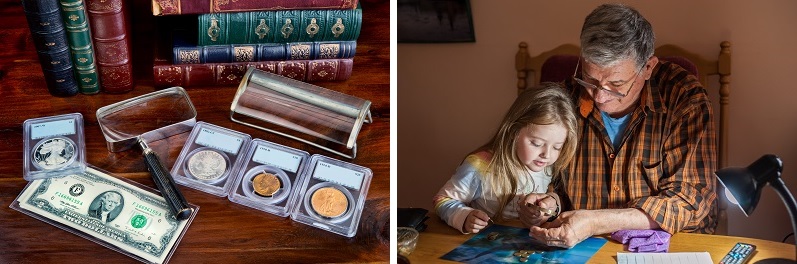
As far as coin buying is concerned, nothing
matches the thrill of making a bid. The ANA sponsors youth auctions,
featured above. Image courtesy of the
American Numismatic Association.
A live auction is perhaps the most
exciting approach to coin buying, especially if you choose to attend one of the major
coin auctions in person. Coin auctions often feature rare, beautiful coins
and draw large crowds. There are a few things to remember as you prepare
to enter the bidding venue:
Make sure you understand the Terms and
Conditions. Do you know how much the buyer's fee is? It is
usually 10-15%, but knowing for sure will help you make good decisions later on.
What credit is available to you? Does the auction company guarantee
authenticity? How are returns handled? What about disputes? If
you ever find yourself engaged in legal action with an auction house, the
judge's verdict may depend heavily on the fine print in the Terms and
Conditions.
Review the auction catalog: Study the
auction catalog well in advance to see what coins are to be on the block and the
sequence and schedule of the sale. Decide what you want to bid on,
prioritize your choices, do your
coin value
trend research, set a ceiling on how much to spend overall and per item of interest, and
know when to be on hand to cast your bids!
Beware of going overboard. Auctions usually are emotionally charged
platforms, and with fast-paced bidding, its easy to let the spotlight cloud your
judgment. Don't bid too high! Stick to your pre-determined limit. Its better for the other guy suffer buyer's remorse.
Keep track of how much you've spent in total. When this level is reached,
experience tells us, it is better to gather up your belongings and head for the
exit, or at least turn in your bidder card. The temptation to continue
bidding is very strong, and you will probably end up spending more than you
really want to.
Bidding by mail. There are quite a few auctions held throughout the
nation, but if you cannot travel to bid in person, most of the better auction
houses permit absentee bidding. In fact, they provide an absentee bid
form, available through their catalog or website. The best way to enhance
your chance of some success through absentee bidding is to make bids on more
coins of interest than you have money to spend, and along with that, specify a
ceiling on how much you are willing to spend overall. The auction company
will keep a running tab on your winnings, and when you reach the specified
limit, no more bids will be placed in your name.
Coin auctions is where
willing buyers come together with willing sellers. The price guides
published by various outfits, in part, base current coin values on the action at
the auctions. To learn about auctions to be held near you, check out the classifieds
in your local newspaper. Most
coin magazines
have a section devoted to previewing upcoming regional and national auctions.
Every now and then, record high prices are set at these events, so if you choose
to attend, be prepared, you might get to witness history in the making!
Coin buying over the Internet has become one of the
most important transaction venues for coin enthusiasts. Coin
collectors are today buying and selling coins through the World Wide Web in
amazing volume. The Internet is fast,
convenient, and a powerful tool for the coin buying bargain hunter. Here are a few ways to capitalize on this
fast growing medium:
eBay.
At any given time, many tens of thousands of coins are being auctioned off on
eBay. There you’ll find tons of interesting, tough-to-find coins, with a better
overall selection than just about anywhere else on earth. Since many of the eBay
sellers are simply collectors like you, a lot of them are willing to sell coins
at “below book” value because the coins are being offered without the assistance
of numismatic professionals (i.e., the “middle man” is cut out). This bodes well
for the coin buyer “looking for a good deal”. As with anything else, there are
some risks involved. By following these simple rules, most of the potential
pitfalls can be avoided: 1) Make sure you understand the bidding rules, 2) Make
sure you understand the return policy of the seller, 3) Study the Feedback
Rating of any possible seller, and avoid anyone with more than just a little
negative feedback, 4) Don’t bother bidding on any coin without a scanned image.
You’re setting yourself up for disappointment, and 5) When an auction is won,
swap e-mail with the seller to determine correct postage and insurance fees,
payment, etc. Bidding on eBay is fun and easy, and seldom is outright deception
encountered (but be careful, and follow the advice given at places throughout
this website where specific coins are recommended for purchase).
Coin Dealer Auctions. Most of the
large coin auction companies have
established bidding websites of their own. Thus, you can attend their live
auctions via the Internet. Some offer tremendous selections to bid on. If you’re searching for the finest coins, you need to check them out
too, as
frequently they have on the auction block truly fantastic rarities. A couple
of the finest coin auction companies accepting bids in real time through
cyberspace include Goldberg Coins & Collectibles and
Heritage Coins. After getting a glimpse of
their quality material, you'll understand why they have such stellar reputations.
Online Stores. Type in the word “coins” in any
search engine and you’ll be flooded with hundreds of online coin dealers. For the coin buyer, this is Nirvana. He
or she can easily compare prices for similar coin
from dealers located all over the world. The selection is incredible, limited only by the amount of time
available to surf the Net. What’s more,
the World Wide Web is open for business 24/7, even on weekends and holidays. Of course, be certain to purchase only from
honorable outfits. Many of the same
common sense approaches outlined at the top of this page in the Coin Dealer
section apply here likewise. Small budget buyers are advised to check out
Kirk Coins, where there are hundreds of lower priced collectible coins to
choose from (if you're interested in value appreciation, though, be sure to
check out our
Coin Value Tables™
first). And then there's
Jake's Marketplace, a fixture in the coin business ever since 1963. Old
coins of all prices and coin supplies at great prices. A one
word description of Jake's: Integrity.
The Internet has permanently
changed the face of coin collecting, for the better. Buyers and sellers
instantly have access to worldwide audiences. The non-stop flow of information and the ease of communication are
widely believed to at least be partly responsible for the strong coin market
we’ve enjoyed since the mid-1990’s. Indeed, the Internet has proven to be a major
benefit to nearly everyone involved in the hobby.
Coin clubs are great for buying coins in person from
other collectors, often at attractive prices. Coin clubs, in general, don’t seem to be as popular as they used to be,
perhaps as a result of new technology providing coin hunters with other means
of finding desirable acquisitions. To
locate a coin club in your area, consult with a local coin dealer. He or she
will certainly know of any active clubs
in the vicinity. Also, www.coinclub.com has quite a few clubs
registered there. If you’re the personality type who enjoys the camaraderie of
others with similar interests and are open to learning new things, then maybe
joining a coin club is the thing for you!
Coin shows are a great place to see thousands of
coins, meet other collectors, learn, and have a fun family outing!
Image courtesy of American Numismatic
Association.
Coin shows are great
opportunities for coin buyers. Having
dozens of coin merchants under one roof makes is easy to compare prices,
grades, and eye appeal. You’ll also have
the chance to visit with other collectors and dealers. If you’re looking for a dealer to work with,
a coin show is ideal for the “interview” process to play out (see
Coin Dealers
section at top of page).
Another benefit of coin shows, often
overlooked, is that it is a entertaining way to get kids interested in coin
collecting. Let them help you find a
proof set minted the year they were born. As the search goes on, you’ll’ stumble onto all kinds of interesting
coin-related subjects and historical topics to discuss. For lunch, treat them
to a Sloppy Joe at the concession stand. Most coin shows have door prize drawings, so make sure your kids sign
themselves up. And doggone it, most coin
show dealers are just downright tickled to have kids stop by, making your visit a
pleasant experience for all. Even if it
turns out your children don’t develop a love for coin collecting as you did,
one thing they will always fondly remember as they grow up is the excursions
with you to the coin show!
Information for upcoming coin shows is
found online at many places, including www.coinshows.com. Check out magazines such as Coin
Worldor
Numismatic News, as they too publish dates, times,
and places for most coin shows held in the United States.
Coin brokers look for extremely rare coins
for their clients. They get paid when
their search results in a sale. If
you’re the type of collector with very expensive tastes but want help hunting
down your numismatic selections, then maybe a broker service is for you. There are always a few brokers advertising
their services in
coin publications.
Before the coming of the Internet, coin buying by
mail was the path used by many collectors to access wider choices. Mail
order still remains popular today with a wide segment of the coin collecting
population.
There are
hundreds of very fine coin dealers scattered across then nation who do a large
volume of business through the mail. One
good aspect of mail order firms is that they usually maintain a large inventory
to choose from. Furthermore, if they offer certified coins by the better known grading services, there is a much smaller chance of
getting shortchanged.
Find a dealer with at least a seven day,
unconditional return policy. Be sure to
promptly inspect your coin delivery when it arrives to make sure it meets your
expectations. Quite a few of the same
questions outlined in the aforementioned Coin Dealers section apply to
any mail order firms you are contemplating doing business with.
Mail order firms can be found advertising
in coin publications. Some of the same coin companies have been advertising in the same
magazines for decades. You can bet these particular outfits place a high value
on customer satisfaction, otherwise they would not have stuck around so long.
However, if you order from
a mail firm who you believe has acted improperly, be sure to inform the
publisher of the magazine where you found the advertisement. The reputation of the publisher could be on
the line, so they won’t hesitate to exert pressure on the company to rectify
the situation.
We’ve all read “Letters to the Editor” in coin publications from collectors bragging about
unbelievable bargains found at estate sales and garage sales. Will you be the next person to discover a
1909-S VDB Lincoln cent in a shoebox full of “old coins”? Probably not, but what the heck…. many people
enjoy the pursuit regardless of the outcome.
Many collectors relish in the search for hidden
treasures at estate and garage sales..
The main caveat here is that coins sold at these residential sales are
about as likely to be overpriced as under priced. Don’t get suckered in when the sale host (who
often knows very little about coins) marks his Good 1964-D dime at $4.00, and
refuses to budge off this price because he is absolutely convinced since the
dime is silver, he’s sitting on top of a great rarity. Ha! At
any rate, estate and garage sales can be fun, and who knows, you might just get
lucky!
The United States Mint is one of the best places to purchase
modern issues of mint state and proof coins. The Mint accepts orders online and is one of the busiest sites on the
Internet. Check out the Mint's current offerings at their
online catalog. If you’re interested in Mint products no
longer being sold through the government, you can still find what you’re
looking for at coin dealer sites,
eBay,
or any of the other coin selling outlets discussed above.