|
| |
US Coin History
|
The Money of the Civil War
|
|
|
Civil War coins offer intriguing North and South subplots. Put in
context of America’s worst war, the story of Confederate coins, US
coins, Civil War tokens, and other Civil War money is described and
illustrated. |
|
Underlying Causes of the
American Civil War |
|
 |
|
A large cotton plantation on the Mississippi
River, by Currier and Ives illustrates a cotton harvest
underway. Field slaves cut the cotton stalks, other hands operated cotton gins
to remove the seeds. After pressed into bales, riverboats, as seen in the
background, transported the cotton to New Orleans for worldwide distribution.
Public domain image.
|
Agriculture was the
primary component of the southern economy, of which cotton production towered in
importance. Indeed, “King Cotton” accounted for over half of all U.S. exports.
Slaves chiefly provided the labor for working in the cotton fields. The
prosperity of the cotton plantations underscored the South’s reliance on the
slave trade, which is why most Southerners associated any perceived threat to
slavery as a direct challenge to their livelihood and culture.
The
North, on the other hand, was heavily industrialized. Immigration was
encouraged to provide the labor supply, as slavery was outlawed. Factories and
railroads were abundant and businesses desired to expand into recently acquired
western territories. Only a small percentage of people living in the North were
dedicated abolitionists, but the concern over competing against slave labor in
the new territories was widely held.
After decades of
industrialization, the northern states became dependent upon an active federal
government to oversee the construction of an effective transportation
infrastructure, and to pass laws designed to look after their financial
interests. The agrarian South was much less interested in a strong influence
emanating from Washington, D.C. and believed that the individual states largely
owned the right to dictate public policy. What’s more, Southerners feared an
overreaching centralized government might abuse its power and meddle with the
institution of slavery.
|
 |
|
Political map of the US of 1856 shows the comparative area of
the free (pink) and slave (gray) states. The green represents territories
not yet committed either way. John C.
Frémont, the first presidential candidate of the Republican Party, and his
running mate, William L. Dayton, headline
the map. The Republican party had been formed in 1854 to counter the
extension of slavery into the West. The existence of a map sectionalizing
the nation was indicative of the interregional antagonism coming into sharp
focus. Image courtesy of
Library of
Congress. |
Prior to
the Civil War, taxes on imported commodities were levied to raise money for
governmental operations. These special taxes were called tariffs and were the
primary source of revenue for the nation (the Feds hadn’t yet discovered the
income tax). The North supported high tariffs, because in addition to raising
money for the federal government, they helped protect their goods from foreign
markets. The South imported most of their manufactured products, and naturally
opposed tariffs and the resultant higher prices.
Dating from the
earliest colonial times, the development of society in the northern and southern
sections of the country diverged significantly. By 1860, the nation had two
distinct sections of the country, often at odds with each other over political,
economic, and cultural issues. Up until then, compromises had kept the Union
intact, but the sectional animosity and distrust finally became so great that a
split could not be avoided.
Following the election of Abraham Lincoln in November 1860, several southern
states seceded from
the Union. War finally erupted in April 1861 when the South fired upon the
federal position at
Fort Sumter, South Carolina. |
Back to Top
|
Southern Strategy |
|
 |
|
Confederate soldiers, 1861, Richmond, VA.
When the first bugle sounded, southerners responded enthusiastically.
Virtually none of them owned slaves, but all believed they were fighting to free
themselves from their domineering brethren of the North, whose economic interests often
ran counter to their own. Image courtesy of
Library of Congress..
|
In 1860,
the South owned precious few economic resources compared to the North, falling far short
in population (9 million vs. 22 million), manufacturing output (8% vs. 92%),
and railroads (9200 miles of track vs. 32000 miles).
In spite of these overwhelming disadvantages, southern
leaders still believed victory was attainable. Their confidence was based on
the fact that the South had to wage a defensive war only, a big plus when
fighting against a larger force.
Superior military leadership, capable of
repelling invading northern armies, was the highest Ace held by the Confederacy.
Amongst the finest southern generals were Robert E. Lee, (who
ironically was offered command of the Union army, but chose to remain loyal to
his beloved Virginia), Thomas "Stonewall" Jackson, and cavalryman
General J.E.B.
Stuart.
Latching
onto that, the sons and daughters of the South rallied around their flag,
convinced their counterparts in the north were not nearly as motivated and would
quickly abandon support for a costly war.
Confederate strategists also anticipated help from Great Britain, whose prominent textile industry relied
heavily on the southern cotton fields. They assumed Parliament would
intervene on their behalf to protect British financial interests.
For the
first two years of the war, the Confederates remained optimistic, as their plan,
in part at least, was working for them. They hoped that by continuing to
hold the northern aggressors to a standstill, the tide of war would eventually
turn in their favor, and their dream of independence would come true. |
Back to Top
|
The Confederate Half Dollar |
|
|
 |
|
The US Branch Mint at New Orleans, as illustrated
on September 11, 1858 by Ballou's Pictorial magazine. Image courtesy of
Louisiana State Museum.
|
At the
onset of the war,
there were three government mints operating in the South, located at
New
Orleans, Louisiana, at
Charlotte, North Carolina, and at
Dahlonega, Georgia.
The New Orleans facility was by far the busiest, minting large quantities of
gold and silver coins.
On January 26,
1861, the State of Louisiana seceded from the
Union and shortly thereafter seized control of the New Orleans Mint. On March
7, Louisiana transferred control of the New Orleans Mint to the Confederacy.
The Mint Superintendent, William A. Elmore,
retained his position only after taking an oath of allegiance to the CSA. The
mints at Charlotte and Dahlonega, seriously lacking a bullion supply, likewise
came under the control of the Confederacy, but were quickly relegated to assay
office status and never factored into the plans of the CSA.
Jefferson Davis and other leaders of the South envisioned minting coins bearing
new CSA designs, to assert their newfound sovereignty and earn the
respect and
possible assistance of European powers. The New Orleans Mint, renamed the Confederate
State Mint, was to be the major hub of coinage activity, as an ample supply of
bullion was available to the Mint, at least initially.
While CSA Treasury
Secretary Christopher Memminger was arranging for the creation of a Confederate
half dollar design, minting of Union half dollars continued as before using the
same federal dies.
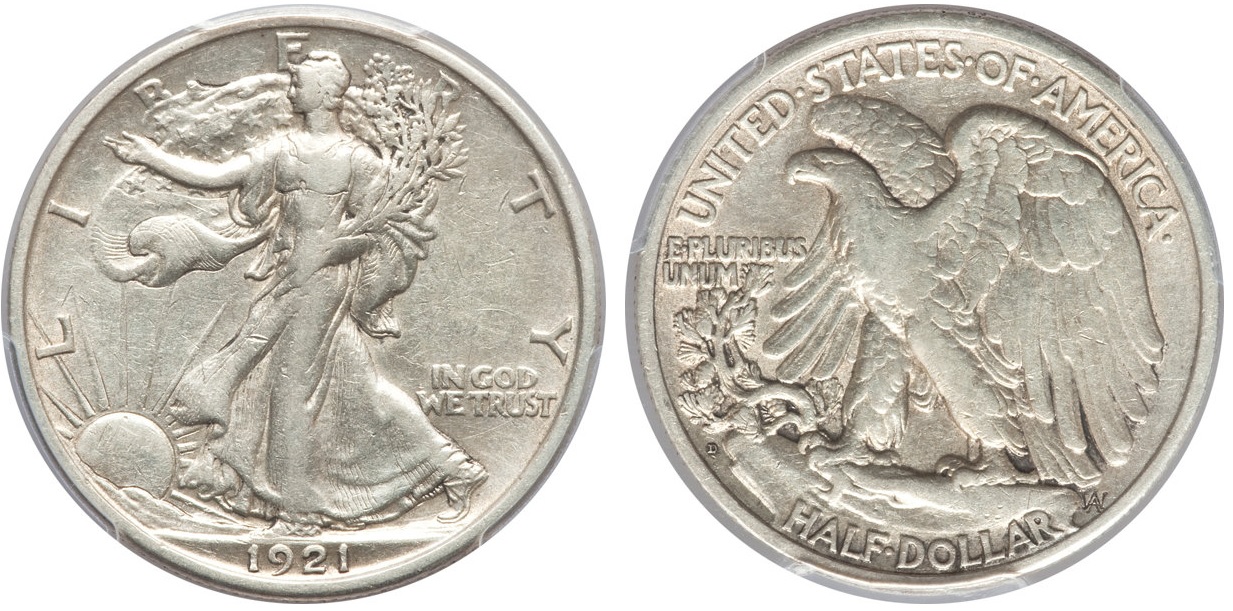
In total, 2,532,633 half dollars bearing the 1861-O date were struck, 330,000
by the authority of the US government, 1,240,000 in February by the State of
Louisiana, and 962,633 under the watchful eye of the Confederacy. Since the
same dies were used throughout this period, it is impossible to tell which
1861-O's were struck by whom. 17,741 gold double eagles were also issued at the New Orleans Mint
during this time, and these too, are indistinguishable, as to authorizing
government entity.
|
 |
|
Restruck in the 1880's by J. Walter Scott from
the original Confederate reverse die, this restrike is nearly identical to the
four authentic CSA half dollars.
Photo courtesy of Ira & Larry Goldberg
Coins & Collectibles, Inc., Beverly Hills, CA.
|
In early
April 1861, Memminger approved of a Confederate half dollar design. The
obverse was to be made from the same Liberty Seated federal die, but the
proposed reverse featured a new Confederate coat of arms, surrounded by cotton
and sugar cane, important symbols of the southern economy.
Before
full scale minting of the CSA half dollar could commence, the price of precious
metals rose dramatically as the reality of war set in, causing coinage
throughout all of America, both north and south, to disappear rapidly. Tangible
assets, such as precious metal coins, were considered a safe harbor in stormy
waters.
Moreover, bullion supplies at New Orleans were exhausted, with no hope of
replenishment any time soon. Given these circumstances, Memminger
concluded that releasing Confederate coinage would be futile, and ordered a
suspension of minting operations.
Little
was it known then, that before shutting down on April 30, four genuine CSA half
dollars were struck by Chief Coiner Benjamin F. Taylor, one of which was
presented to President Jefferson Davis. Taylor kept one of the half
dollars for himself, while the other two went to local dignitaries. Taylor
also retained possession of the dies.
In the
absence of circulating coinage, the Confederacy and several states printed paper
money. In addition to printing notes of greater dollar denominations,
fractional notes, also known as “paper coins” having faces values less than one
dollar, entered the channels of commerce.
In April
1862, Union forces under the command of Captain David Farragut, captured the
city of New Orleans. With the primary minting facility in the hands of the
North, the goal of establishing a secure coinage system indicative of a
self-sufficient Confederacy began to fade badly.
On May 10, Confederate
President Jefferson Davis was taken into custody by Union troops at Irwinville,
Georgia, marking the formal end of the Confederacy and the American Civil War.
Four long years of widespread destruction and intense bloodshed, claiming the
lives of over 600,000 Americans, had mercifully come to an end.
Writing
publicly in early 1879, former CSA Chief Coiner B.F. Taylor revealed the
existence of the four original 1861 Confederate half dollars. Responding to
Taylor’s disclosure, Jefferson Davis admitted that at the moment of his capture
in 1865, he was still carrying the Confederate half dollar given to him four
years earlier, but indicated it was stolen at the time of his arrest.
Later in
1879, Taylor sold his Confederate half dollar and dies to E. Mason Jr. of
Philadelphia, who in May resold both the coin and the dies for $310 to J. Walter
Scott, a New York coin and stamp dealer. In 1882 Scott sold the half dollar for
$870, but chose to hang onto the dies for the purpose of manufacturing
restrikes. After refurbishing the old dies, Scott produced 500 white metal
tokens, successfully testing the Confederate reverse, pairing it up with a
homemade Scott Company obverse die.
|
 |
|
Inscribed on the Scott obverse: 4 ORIGINALS
STRUCK BY ORDER OF C.S.A. IN NEW ORLEANS 1861 ******* REV. SAME AS U.S. (FROM
ORIGINAL DIE SCOTT). Scott used his "front" side die while testing the
manufacturing worthiness of the Confederate half dollar reverse die. Photo of a modern day replica of
Scott token obverse.
Photo courtesy of Ira & Larry Goldberg
Coins & Collectibles, Inc., Beverly Hills, CA.
|
Pleased by the results
of the white metal tokens, Scott then proceeded to obtain from circulation 500
half dollars dated 1861 in various conditions and used these for restrikes. At
first, he struck the Confederate die directly onto the reverses of a few of
these half dollars, but some of the federal reverse was still visible. To
overcome this problem, Scott then completely “shaved off” the reverse design
from what remained of his 500 half dollars before continuing to make restrikes.
Today,
the Confederate half dollar specimen originally belonging to B.F. Taylor is
housed in the collection of the American Numismatic Society in New York City.
Two of the other half dollars are also privately held. The fourth authentic 1861 strike was actually found circulating in New
York late in the 19th century (perhaps the specimen stolen
from Jefferson Davis?), and was sold on October 14, 2003 for an astounding $550,000.
Prior to
the 2003 sale, it had
been many years since any of the four genuine Confederate half dollars were sold.
Based on this high level of interest in Confederate-related coinage, we can
safely conclude that J. Walter Scott’s white metal restrikes could easily bring maybe $800 to
$3000, depending upon condition. Scott’s half dollar restrikes are worth $3000
to $6000, again depending upon condition, although the small handful of his
restrikes onto “unshaved” 1861 half dollars are very rare and command much
higher prices. All of Scott’s restrikes are easy to distinguish from the four
genuine CSA half dollars because the obverses were distorted and flattened
during the restrike action.
Four lonely Confederate half dollars are the highest
profile survivors of a long-ago vision to establish a coinage system
representing southern values. From President Jefferson Davis on down, the
South's leaders believed distinctive coins, indicative of a self-reliant nation,
would help them achieve independence. Many numismatists nowadays wish
there were more CSA coins available to collect from the Civil War, the most
crucial episode in America's past. Imagine how the road of history might have detoured
from the path we know today had the Confederacy's desire to mint millions of its
own coins been fulfilled. Who knows, the short-lived republic might not have been so
short-lived after all. |
Back to Top
|
First Bloodshed |
|
The
shelling of Fort Sumter electrified and united most of the North. Many people,
including President Abraham Lincoln, expected the southern rebellion to be put
down rather quickly. Lincoln’s first call for volunteers provided for only
three-month enlistment terms. In July 1861, Lincoln dispatched an army of
30,000 half-trained men toward Richmond, Virginia, the capital city of the
Confederate States of America, only to be met by a stubborn rebel force near
a small creek called Bull Run. Many citizens from the Washington area, dressed
in fine clothes and toting picnic baskets, accompanied the federal troops,
expecting to observe the “end” of the rebellion, as if it were to be
accomplished through some sort of bloodless spectator event.
|
 |
|
Pictured above are the ruins of the stone bridge over the Bull
Run river, near Manassas, Va. It is at this very spot where the first major
battle of the Civil War began, July 21, 1861. Image courtesy of the
National Archives.
|
What happened at the
[First] Battle of Bull Run did not follow the script Washington power brokers
had envisioned. While gaining the upper hand at first, Union forces were
quickly routed as Confederate reinforcements, under the command of General J.E.
Johnston and General Thomas “Stonewall” Jackson, arrived on the scene.
The
roads back to Washington were filled with wild panic-stricken soldiers in full
retreat. Joining the flight were the civilian observers, horrified by the
defeat and carnage they had just witnessed. For the next few days,
Washingtonians trembled in fear as rumors spread of approaching Confederate armies to
lay siege to the city. Fortunately for the Federals, the Confederates, too, were
disorganized and exhausted from their triumph at Bull Run, and failed to grab
the opportunity to march on Washington.
Following the defeat at Bull Run, it was clear the North was not going to
steamroll the South into submission anytime soon. Talk of a short war ended. |
Back to Top
|
The Yanks Adapt to Coin
Shortages |
|
|
 |
|
1860 Liberty Seated dollar. Coins just like were
hoarded when the magnitude of the Civil War crises came into sharper focus.
Image courtesy of Jake's Marketplace.
|
As
reality of a prolonged conflict hit the home front, the availability of
circulating coinage became an early casualty of war. Facing a very uncertain
future, both ordinary citizens and speculators hoarded precious metal coins,
saving them for what many feared would be bleak times ahead.
In late 1861, the
U.S. government suspended specie (i.e. gold or silver coins) payment of its
obligations, causing the precious metals market to rise sharply, which in turn,
caused even more coins to vanish from circulation, including the
copper-nickel (88% copper, 12% nickel) Indian Head cent.
By the
end of 1862, virtually all coins had disappeared from commerce. The
Philadelphia Mint continued to issue new coins, but these were quickly gobbled up and set aside by the
public.
|
 |
|
Encased postage stamp, having face value of 10 cents.
Graded Choice Very Fine, this specimen is worth a few hundred dollars on today's
market. Image courtesy of
EarlyAmerican.com.
|
In the absence of
coinage, completing everyday business transactions became difficult. The
national economy threatened to grind to a halt. For instance, shopkeepers
couldn’t make small change for their customers.
Some individuals began using
readily available postage stamps as an exchange medium, an idea that swiftly
became popular. But because postage stamps were manufactured for one-time only
use, understandably, they were not sufficiently durable for multiple
transactions.
John Gault of Boston patented a stamp encasement device to extend
the life of a stamp, but at a cost of two cents each, this proved for many to be
too expensive for the smallest denominations.
A better solution for
the coinage crisis originated from within the entrepreneurial sector, appearing
first in Cincinnati, Ohio. In the fall of 1862, several merchants contracted
with private diesinkers to fabricate cent-sized tokens, which carried an implied
guarantee (or sometimes an outright declaration) of redemption in merchandise,
services, or currency. These “coins”, later to become recognized by the
collecting community as Civil War tokens, were welcomed by the public and helped
considerably to assist in business transactions.
It is
estimated that at least 25 million Civil War tokens were produced, with over
8500 distinct types catalogued. Patriotic themes and advertisements were the
primary subject matters. Tokens were composed of various materials, including
brass, copper-nickel, zinc, hard rubber, and most importantly, bronze (95%
copper, 5% tin and zinc). Some of the tokens mimicked the design of the Indian
Head cent, being sure to include the word NOT above the ONE CENT, in order to
protect the originator from being charged with counterfeiting.
By 1864, several
influential companies started complaining that they were being “stuck” with
large numbers of these private tokens, unable to redeem them for cash from the
issuing merchants. In mid-1864, with the new bronze Indian Head (see two
sections below) cents
circulating in record quantities and the end of the Civil War in sight, Congress
authorized a law making it illegal for private businesses or individuals to
issue money of any sort, forcing Civil War token makers out of business.
Civil war token collecting is a fascinating segment of today's numismatic
environment. For anyone desiring to study the subject in greater depth, we
recommend visiting the Civil War Token
website. There, you'll find a great deal of detailed data on tokens, plus
a salute to those who served during those tumultuous times.
The Lincoln
administration, for its part, also took action to address the country’s monetary
problems. For the first time, the U.S. government issued paper money unsecured
by gold, silver, or government bonds. Some $450 million of “greenbacks” were
printed, whose value fluctuated depending upon the latest good or bad news
coming from the warfront.
|
 |
|
Example of fractional currency, issued 1863, face value 10
cents. Image courtesy of
EarlyAmerican.com.
|
Also to
relieve the coin shortage, the government responded by issuing $50 million of
fractional paper currency, as small as three cents face value.
During
inflationary periods, small fractional notes were virtually worthless, and
earned the derogatory nickname “shinplasters”.
The term originated from the
Revolutionary War, when American soldiers used their Continental Currency pay as
bandages for leg injuries. Since few vendors trusted the Continental Currency,
the notes actually had more value to the troops as medical supplies!
The
federal government was not the only entity to print paper money. Many states,
banks, companies, and individuals also issued notes, technically called “scrip”
(this situation occurred in southern states as well). This caused a great deal
of confusion, providing cover for counterfeiters on a massive scale.
Congress
established the National Banking System in 1863 to provide regulation to the
banks and to craft a uniform national currency. The government heartened
private banks to apply for charters to earn “national bank” status. To begin
issuing new “national bank notes”, a bank was required to use its funds to
purchase U.S bonds, to then be turned over to the Treasury. The amount of
national bank notes a bank was permitted to issue was up to 90% of the value of
the bonds on deposit by the bank with the government. Not only did the National
Banking System provide currency uniformity leading to the demise of private
scrip, it also helped sell federal bonds for financing the war.
|
Back to Top
|
The Emancipation Proclamation
Shifts Focus of the War |
|
|
 |
|
Ambrose Burnside, one of many generals to occupy the Union
army's top post, saw his troops decimated at Fredericksburg, taking 13000
casualties to the South's 5000. A frustrated President Lincoln replaced
him with Joseph Hooker, who proved to be equally unsuccessful.
Ironically, Burnside is best remembered for his bushy side whiskers, a style
which became known as "sideburns". Image courtesy of
Library of Congress.
|
As the
coin shortage developed into a serious issue for the Union during 1861 and 1862,
it was still probably not at the very top of President Abraham Lincoln’s list of
concerns.
Mixed
battlefield results, including setbacks at the First Battle of Bull Run, in the
Shenandoah Valley of Virginia, the Peninsula Campaign, the Second Battle of Bull
Run, Fredericksburg, and others, prompted Lincoln to desperately search for a
military commander to match the brilliance of Generals Robert E. Lee and Thomas
“Stonewall” Jackson of the Confederacy.
At one
time, the Confederate army was so close to Washington that Lincoln seriously
contemplated evacuating the city. Indeed, the outcome of the war remained
very much in doubt for a long time.
Very
early on, Lincoln’s stated goal in waging war with the South was to preserve the
Union, and not necessarily to end slavery. As the conflict dragged on into
its second year, Lincoln became convinced that federally mandated emancipation
of slaves would ultimately benefit the North’s prospects for victory. For
one thing, public sentiment had been building for the abolition of slavery, and
a bold governmental decree to do so could provide the rallying point to
transform the war of reunification into a fight for freedom, laden with moral
overtones. Secondly, Lincoln wanted to embolden runaway slaves to join the
Union’s cause; already thousands had attached themselves to the northern army,
and many more would follow if encouraged. Thirdly, several European
nations, including Great Britain and France, were flirting with the idea of
assisting the Confederacy. If Lincoln could do something to clearly
identify the South with the institution of slavery, the likelihood of foreign
intervention would be reduced, owing to the strong anti-slavery opinion held in
those countries. And lastly, on a personal level, Lincoln long held a
desire to see all people shed the chains of bondage.
|
 |
|
An Emancipation Proclamation poster, announcing
freedom to most slaves. Image courtesy of
Library of Congress.
|
On
September 22, 1862, five days after the North’s marginal win at bloody Antietam,
Maryland, Lincoln announced his intention to soon publish a formal edict, for
the purpose of freeing all slaves living in states taking up arms against the
Union.
On
January 1, 1863, the Emancipation Proclamation was issued, which, in part,
declared that all “slaves within any State, or designated part of a State … in
rebellion …. Shall be then, thenceforward, and forever free.”
In
addressing the political intricacies in place at the time, the Emancipation
Proclamation freed no slaves living in states remaining loyal to the Union
(Kentucky, for example), or in former Confederate areas then occupied by northern
armies. To the more than 3 million slaves whom the Proclamation applied
to, liberty did not come immediately, either, as Confederate forces still
maintained control of those locales.
|
 |
|
Company E,4th U.S. Colored Infantry, Washington D.C.
Serving in segregated units like the one shown here, blacks fought in nearly 500
Civil War battles. Image courtesy of
Library of Congress.
|
While
Lincoln’s critics complained the Emancipation Proclamation pertained only to
regions where he did not have the capacity to enforce it, the impact of the
document was far-reaching.
As
hoped, it expanded support for the war, elevating the Union’s purpose to a
higher moral plane. At least 200,000 black soldiers, many of them former
slaves, swelled the Union army’s ranks.
Strong
anti-slavery sentiment in Europe precluded governments there from intervening on
behalf of the Confederacy, now clearly linked as a defender of the institution
of slavery. What's more, the Emancipation Proclamation built dramatic new
momentum toward the complete abolition of slavery in the United States,
culminating with the enactment of the 13th Amendment to the
Constitution in 1865.
|
 |
|
Inside the Lincoln Memorial, where Honest Abe
sits in perpetuity. Image courtesy of
ThisNation.com.
|
As for
Lincoln himself, the Proclamation significantly enhanced his historical legacy,
being forever remembered as the Great Emancipator. In modern times, the
Lincoln Memorial in Washington D.C. has been the rallying point of civil rights
demonstrations.
More
than any other individual, Lincoln is credited with setting the slaves free,
thus bringing the nation closer to the ideal set forth in the Declaration of
Independence that “all men are created equal”.
|
Back to Top
|
New Bronze and Nickel Coinage
and "In God We Trust" |
|
As mentioned a couple of sections above, the metallic value
of the "nickel" Indian Head cent soon outpaced its face value, virtually
disappearing from view by the end of 1862, just as did its silver and gold coin
siblings earlier. To compensate for the lack of coinage, numerous
enterprising individuals produced a variety of tokens, most of them composed of
bronze (95% copper, 5% tin and zinc), to help facilitate business transactions.
The tokens were easier to manufacture than Indian Head cents, since they were
thinner and because bronze is more ductile than the nickel alloy used in the
cent. Even better, bronze is a relatively cheap metal.
|
 |
|
1864 Indian Head, the first year of the "bronze"
cent. The new metallic composition stayed with us nearly every year until
1982. Image courtesy of Jake's Marketplace.
|
Mint officials observed the advantages of thinner, bronze
composition coins. The ease of manufacturing was an obvious plus.
The bigger lesson though, is that for decades, they had erroneously thought the
public would not accept a coin having a face value far greater than its intrinsic
metallic value.
The quick recognition of privatized tokens indicated people
would probably acknowledge fiat money (money that is not backed by precious
metals but is legal tender by governmental decree), especially in a coin-hungry
society, for the convenience of making exact payments, without regard to the
intrinsic value of the small change involved.
Mint Director James Pollock recommended in his annual
report of 1863 that the cent be made thinner and composed of bronze. On
April 22, 1864, legislation was finalized to act upon Pollock’s advice.
The introduction of the "bronze" cent was successful and circulated freely.
Consequently, record numbers of cents were minted in 1864 and 1865.
|
 |
|
Priest celebrating mass for the 69th New York
State Militia, Fort Corcoran, Washington, D.C. Religion was an important
motivating force for many soldiers who served in the Civil War.
Image courtesy of National Archives. |
The 1864 law ordering the makeover of the cent also
authorized the two cent coin, made of bronze as well.
The new two cent issue bore for the first time ever on an
American coin the motto "In God We Trust", a response to the religious passion
sweeping the country as the Civil War crises raged on.
At first, the two cent coin was quickly absorbed by the
coin-starved public. The Mint produced almost 20 million pieces in the
first year, to satisfy the high demand. Like the bronze Indian Head cent, the two
cent coins readily mingled with society. The year 1865 saw the production
of 13.6 million two cent coins. After the war, coin hoarding stopped, and
more familiar denominations reappeared. Interest in the two cent coin
waned, and mintage quantities declined correspondingly. In 1872, a
miniscule 65,000 were struck. Finally in 1873, the last year of life for
the two cent coin, only 1000 or so proof specimens were turned out.
|
 |
|
The 1864 Two Cent coin had inscribed IN GOD WE
TRUST on the obverse side ribbon, the first time ever for a US coin, and the
beginning of a longstanding tradition. Image courtesy of Jake's Marketplace.
|
At the time of its cancellation, the two cent coin was held
in low regard. In retrospect, however, the coin helped pull our country
through some of its darkest days, by fulfilling an important economic need and
by inspiring confidence in the Almighty.
The motto it introduced has endured for 140 years, becoming
one of the most visible trademarks of the United States of America. It
wasn't until 1955 that Congress mandated all US coins carry the "In God We
Trust", but by then, of course, it was a mere formality.
In 1865, another three cent coin made its debut, this one composed
of a 75% copper, 25% nickel alloy. Government officials hoped it would
replace the vanished silver three cent coin of smaller diameter. Some
historians contend the nickel mining industry was the true force underlying the
genesis of the nickel three cent coin. At any rate, nearly 11.4 million of the
pieces were churned out the first year, and for a while, they assisted the
public reasonably well.
|
 |
|
In 1865, a new alloy was introduced with the
nickel Three Cent coin. Eventually, the coin itself faded into oblivion,
but the "nickel" composition lives on. Image courtesy of Jake's Marketplace.
|
But just as with the two cent coin, when the War Between
the States concluded, pre-war coin circulation patterns resumed, and the
copper-nickel three cent coin fell out of favor. In addition, critics
bemoaned the fact that the coin’s size too closely resembled the dime.
Production ceased completely after 1889.
Despite its mundane story, the nickel three cent coin did
indeed leave an indelible mark on American money. The 75% copper, 25%
nickel alloy proved to be a suitable material for coining purposes, and was
selected in 1866 for a new five cent coin, to become known as a “nickel”, a term
carried through to this very day for circulating five cent coins. |
Back to Top
|
The Winds of War Turn Against
the Rebels |
|
The year 1863 began with
discontent settling in on both sides. The South's goal of winning
European support was slipping away, while the North, victorious in the western
front, suffered many defeats in the East. As Lincoln fired top generals
one after the other while searching for just the right commander to lead the Union army,
the capture of Richmond seemed only a remote possibility.
|
 |
|
General Robert E. Lee, commander of the Army of
Northern Virginia, revered to this very day throughout many parts of the South
and elsewhere.
After the war, Lee became president of Washington college, but was denied
amnesty. In 1975, Lee's citizenship was restored by an act of Congress.
Image courtesy of
Library of Congress. |
This was the situation in
June 1863 when General Lee moved the Army of Northern Virginia, consisting of 75,000 men, northward across
Maryland and into Pennsylvania. Lee was hoping that if he could successfully
invade a northern state, the Union would seek terms to end the war. Lee
also had another purpose for invading the North. In the West, General Ulysses S.
Grant of the Union army had laid siege to Vicksburg, a city guarding traffic up
and down the Mississippi River. The fall of Vicksburg threatened to split
the Confederacy, so Lee needed another front to perhaps cause the Yankees to
reallocate resources away from Vicksburg.
On June 30, advance patrols
of the Confederate and Union armies skirmished near the Pennsylvania village of
Gettysburg, drawing many thousands of soldiers to the vicinity. For the next two days, major elements of both sides fought fiercely for
positioning on the hills around Gettysburg.
Lincoln's latest replacement for
leader of the Army of the Potomac, General George Meade, established a line of
defense on high ground along what is now called Cemetery Ridge. About a mile to the west,
Lee's infantry and artillery occupied Seminary Ridge. Separating the two
armies was a large open field. The stage was set for an epic event that proved
to be a turning point in American history.
|
 |
|
Many of the surviving Confederates reaching the
top of Cemetery Ridge were
killed or captured. These southern soldiers were taken prisoner by the
Yankees, but at least they lived to one day tell their grandchildren the story of Pickett's
Charge and the Battle of Gettysburg. Image courtesy of
Library of Congress. |
On July 3, Lee gambled the
fate of the Confederacy on a chance for victory, ordering General
George Pickett to lead 15,000 of the South's finest troops in a massive charge
across the open field and up Cemetery Ridge, in a bid to break the center of the
Union line.
As the Confederates charged,
Union gunfire and artillery shredded their ranks. Nearly three-fourths of
Pickett's division was lost before reaching the top. For a brief moment, the Stars and Bars flew at the crest of
Cemetery Ridge, but Union reinforcements repelled the Confederates off the ridge
and into total defeat. Pickett's Charge had failed. As night came and the
guns fell silent, thousands of southern dead, the best the Confederacy had to
offer, lay dead on the battlefield. The South's clearest prospect for winning
the War Between the States had turned into disaster.
On the evening of July 4, the
87th anniversary of the Declaration of Independence, Lee started his somber
retreat back to Virginia in the midst of a driving rainstorm. The
overcautious Meade chose not to pursue the Confederate forces. A dejected
Lincoln later removed Meade from command for failing to chase down and destroy the
remnants of Lee's army.
|
 |
|
Numismatists have long honored the memory of the
Civil War. In this 1936 Battle of Gettysburg commemorative coin, Union and Confederate soldiers
are shown on the obverse. Two shields representing the opposing armies
grace the reverse.
Photo courtesy of Ira & Larry Goldberg
Coins & Collectibles, Inc., Beverly Hills, CA. |
The same day Lee abandoned
Gettysburg, the Union won another decisive victory with the fall of Vicksburg.
By taking control of the Mississippi River, the key
objective of splitting the Confederacy in two was accomplished.
So in
the first week of July 1863, the winds of war turned solidly against the South,
with crucial defeats at Gettysburg and Vicksburg. Food shortages, inflation,
and low morale now seriously began to plague the Confederacy. More
spectacular battlefield losses followed in 1864 and 1865, finally sealing the
doom of the rebels. |
Back to Top
|
The End of the Confederacy |
|
 |
|
Meeting aboard the River Queen, artist
G.P.A. Healy's "The Peacemakers" shows a conference attended by (l-r) Gen.
William T. Sherman, Gen Ulysses S. Grant, President Lincoln, and Adm. David
Porter. A rainbow can be seen in stormy skies through the window.
Image courtesy of
White House Collection.
|
The improvement of coin
availability in 1864 and general economic recovery in the northern states can
also be tied to the favorable direction the war had taken for the Union.
In March 1864, Lincoln
appointed General Ulysses S. Grant as the top commander of the Union army.
Students of the Civil War frequently point out that Grant was not the dazzling
tactician in the class of Robert E. Lee. Perhaps not, but Grant understood
his edge in numbers and materiel, and ruthlessly utilized them to the North’s
advantage. At long last, Lincoln found a general who could consistently
win.
|
 |
|
Gen. U.S. Grant leans over church pew to study
map held by Gen. George Meade, May 21, 1864 Massaponax Church, Va. In a
rare moment of relaxation, Grant's men can be seen smoking pipes, reading, and
engaging in humorous conversation. Image courtesy of
Library of Congress.
|
Grant selected General
William T. Sherman to take control of a large force in Tennessee, and move south
toward Atlanta, Georgia.
In heavy fighting along the
route, Sherman inflicted numerous defeats upon the Confederacy. Noting
that “war is hell”, Sherman then made it so by deliberately striking out at the
civilian population, destroying everything in a 60 mile wide path from Atlanta
to the coastline.
Even though there was not
much intentional killing of civilians, thousands of homes, farms, and livestock
were wiped out, anything of possible use to the southern cause, thrusting a
fatal dagger into the heart and hopes of the Confederacy.
|
 |
|
Louis Guillaume's 1867 painting portrays the
surrender of Lee to Grant with mutual respect and kindness. Terms of the
surrender were generous. Grant arranged food rations to be distributed to
the hungry Confederates. Lee's troops were allowed to return to their
homes and keep their horses. The high character of both men during the
meeting has led historians to call it "The Gentlemen's Agreement".
Image courtesy of Appomattox Court
House National Historic Park.
|
As Sherman moved northward
through the Carolinas, Grant plowed his way through Virginia toward Richmond,
capturing the Confederate capital city on April 2, 1865.
Hopelessly outnumbered and
surrounded, Lee sent word to Grant on April 7 that he wished to talk.
Dressed in his finest uniform, Lee surrendered to Grant two days later at the
Wilbur McLean farm house, located near the small town of Appomattox Court House,
Virginia.
This was not the first time
the two men had met. They remembered one another as young officers in the
Mexican War, and chatted for some while about that experience before getting
down to business.
Displaying great mutual respect, the generals shook hands and parted company on
agreeable terms. Confederate soldiers were sent home, keeping their horses
to ease the transition back to peaceful farm life. Officers were permitted
to keep their pistols. Gratefully, there would be no mass punishment for
the rebellion.
Upon hearing the news of
Lee's surrender, other Confederate generals, realizing the end of the
Confederacy had come, waved the white flag to avoid further useless killing.
At long last, the bloodiest chapter in United States history had thankfully been
concluded. In all, at least 600,000 American soldiers bravely paid the
ultimate price for the causes they believed in. |
Back to Top
|
Lincoln's Assassination Stuns
the Nation |
|
Lincoln’s blueprint to reconstruct the south centered on clemency. As his
second term commenced on March 4, 1865, Lincoln eloquently outlined his plan in
his “With malice toward none” inaugural address. Lincoln clearly believed
forgiveness was critical for binding the nation’s wounds.
|
 |
|
This Currier and Ives lithograph captures a
tragic moment in American history, the assassination of Abraham Lincoln.
The President was buried in his native Illinois. Image courtesy of the
Library of Congress.
|
On April
14, less than a week after Lee surrendered to Grant at Appomattox Court House,
President Lincoln decided some relaxation was in order. He and Mrs.
Lincoln attended Ford’s Theatre that evening in downtown Washington, D.C. to
enjoy a comedy, Our American Cousin.
At
10:13, a gunshot echoed throughout the theatre, and the President immediately
slumped forward in his chair, with a bullet in the back of his head, shot by a
crazed actor named John Wilkes Booth. Lincoln was quickly rushed out of the
building to a house across the street, but there was little anyone could do.
At 7:22 the following morning, he passed away. As Lincoln drew his last breath,
Edward Stanton, one of the President’s closest advisors, sadly intoned “Now he
belongs to the ages.”
|
 |
|
The Lincoln cent was introduced in 1909,
to commemorate the 100th anniversary of Abraham Lincoln's birth. Image
courtesy of Jake's Marketplace.
|
In his
lifetime, Lincoln was reviled by many on both sides of the Mason-Dixon Line.
To put this into perspective, for a while there was actually some doubt whether
or not he
would win re-election in 1864.
The passage of time, however, has largely removed the last vestiges of hatred,
and today he is widely regarded as a champion of human freedom and true hero of
American history. To that end, his likeness adorns our one cent coin and
five dollar bill, a fitting honor for a man deeply committed to the principles
of democracy and liberty for all. |
Back to Top
|
Recommended Reading |
|
The
American Civil War is a fascinating topic to study. Visiting a civil war
battlefield today leaves one in awe, as visions
come to mind of those
brave souls who gave the “last full measure of devotion” on that very same
ground. The titanic struggles between the North and the South, the immensity of
the battles, and the courage and dedication to duty displayed by the opposing
sides are what legends are made of. The events leading up to secession,
the war itself and its aftermath, dominated and shaped the development of the
United States, politically and socially, for generations. Without a doubt,
the War Between the States was the single most defining event in American
history.
|
|
|
The best historians frequently quote from
The
Civil War: A Narrative, considered to be one of the finest works ever
assembled on the conflict.
|
We’ve touched upon a
few of the more notable events of the Civil War era, but much of the saga
remains untold. Perhaps the most comprehensive treatment ever of the
American Civil War is Shelby Foote’s
The Civil War: A Narrative. A wonderfully written trilogy of books,
fairly balanced, and historically accurate, Foote writes in a style resembling
an easy reading novel. Measuring over 3000 pages, the author spent 20
years researching the material, and it shows.
Main drawback: not many
visual aids. Don't expect pictures to tell the story. This trilogy
is strictly for sophisticated readers who appreciate the challenge of using
their imaginations to set the stage. Secondary drawback: Foote uses his
considerable narrative talent to skillfully bring you closer to the main
characters. You can be left a little watery eyed when their various
stories end, such as with Lincoln’s last moments. The overall evaluation,
however, is that this epic deserves a place on the bookshelf of any Civil War
buff.
We owe much of what we
know today about the Civil War to Mathew Brady, who took many hundreds of
photographs during the tragic era. As they say "a picture is worth a
thousand words", so Brady's contribution to history is priceless. Through
his foresight, Brady eternally preserved images of important people, sweeping
panoramas, the everyday lives of soldiers, and battlefield horrors. Anyone
with a respect for the past can appreciate the collection Brady handed off to
future generations. Mary Panzer, curator of photographs at the National
Portrait Gallery in Washington, D. C., examines his work in
Mathew Brady and the Image of History.
It seems as if Brady
showed up with his camera anywhere a major Civil War story was unfolding, even
more so than the ubiquitous "Kilroy" of WWII fame. Actually, Brady's
efforts were augmented by at least two able assistants, Timothy O'Sullivan and
Alexander Gardner (dare we call them the "Brady Bunch"?). Yes, many of
Brady's photos can be seen free at the National Archives or Library of Congress
websites, but in her book, Panzer combines some of Brady's best with terrific
text to place the images into proper context. There are LOTS of super
Civil War books available at Amazon, but this is one of the few we'll take the
time to recommend.
In this
section we’ve written quite a bit already about the accomplishments and failures
of the Union and Confederate monetary systems during the American Civil War.
Still, the information presented here is but a mere summary.
Serious
numismatists should turn to Richard Doty’s reliable standby
America’s Money, America’s Story for an awesome detailed adventure into the
various exchange media used in America from the earliest days to the present.
Don't expect a fun, fast moving entertainment novel, however. Doty is a
"Joe Friday" type of author who gives the reader "just the facts, ma'am".
We appreciate diligent research, and so we'll give Doty a round of applause for
his excellent work.
There is
an extensive chapter on the Civil War, explaining the intersection between the
flow of history and our nation’s money.
To a
lesser degree, we utilized
The
Comprehensive Catalog and Encyclopedia of U.S. Coins in preparing this Civil
War section. The book’s main strength, however, is its overall breadth of
numismatic coverage, useful for beginners or experts. A worthy addition to
anyone’s library.
Ditto
for Barry Krause’s
Collecting Coins for Pleasure & Profit.
Out of the hundreds of excellent Civil War books for sale,
there are just a few more we'll recommend as absolutely outstanding. When
these arrive in your mailbox, * YOU WILL BE PLEASED* with your selection.
An incredible compilation of 500 photos, engravings, and paintings.
The
Civil War: An Illustrated History, as the name implies, is profusely
illustrated, accompanied by a well prepared text.
Written by Geoffrey Ward, this book has to be one of the finest ever published
on the subject, covering events leading up to the war, the war itself, and the
fallout beyond Appomattox Court House.
The viewpoints of both military and civilian, North and South, are explained.
Very enjoyable to read, with text planned out so that the reader can easily come
and go without loosing "plot momentum". That's good, because it will take
weeks to digest all the thought-provoking material. After that, put it on
your living room coffee table as a conversation piece.
Stunning artwork. Absolutely stunning. That's what you'll find in
Witness to the
Civil War: The Art of John Paul Strain. The artist creates images so
lifelike and true to history, that their value to students of the Civil War
rivals actual photographs from the era. Realistically depicting in vivid
color images of brave soldiers, frightening combat scenes, and touching moments,
Strain combines his unbelievable artistic skills with detailed knowledge of the
period to bring the War Between the States to your living room. For the
Civil War buff who thinks he's seen it all, this one is for you.
BE CAREFUL!
You will fall in love with the artwork of John Paul Strain, so much so
that you may feel compelled to purchase a few framed prints of these marvelous
paintings for your home or office. There are lots of places out there on the Net
where you can purchase John Paul Strain's wonderful creativity. But
please, don't say you weren't warned here first!
Not everybody wishing to learn more about the Civil War has time to pour through
a gigantic text. For those of you falling into this category, then
The Timechart History of the Civil War is the answer. This is a brief
(but not too brief) timeline summary, loaded with the essential facts supported
by superb images and sidebars. Excellent battlefield maps make it easier
to understand troop movements and strategies. Interestingly, some of the
old photos have been colorized, adding new perspective to familiar faces.
Don't expect
a colossal amount of detail. That is not the intent of the publisher.
Rather, it is a concise, well-researched effort that is greatly admired by those
of us who hold in high esteem the men and women who sacrificed greatly during
the War for causes they believed in.
When
Amazon brags about having the largest book selection on Earth, they ain't just
a braggin'. It's true! New and Used books at reduced prices can also be found
directly through their website. To see what else is available on
coins, the
Civil War, American history, or anything actually, we've provided this handy
little Search box linking to Amazon's vast database. Type in a keyword relating
to your favorite subject and behold the amazing selection!
|
Back to Top
|
References |
| 1 |
Allen, Jack, and John L.
Betts. History: USA. New York, NY: American
Book Company, 1967. |
| 2 |
Brinkley,
Douglas.
History of the United States. New York, NY: Penguin
Putnam, Inc., 1998.
|
| 3 |
Coin World Editors. The
Comprehensive Catalog & Encyclopedia of US
Coins.
Iola, WI: Krause Publications, 1998. |
| 4 |
Doty,
Richard.
America's Money, America's Story.
Sydney, OH: Amos Press, Inc., 1998. |
| 5 |
Foote,
Shelby.
The Civil War: A Narrative, 2nd ed.
New York, NY: Vintage Books, 1986.
|
| 6 |
Jordan,
Winthrop D., Miriam Greenblatt, & John S. Bowes. The Americans.
Evanstan, IL: McDougall, Littell & Company, 1988.
|
| 7 |
Krause,
Barry. "Tracking the Confederate Half."
The Numismatist, March 2001, pp. 285-289, 339.
|
| 8 |
Krause,
Barry.
Collecting Coins for Pleasure and Profit.
Crozet, VA: Betterway Publications, 1991.
|
| 9 |
Orzano,
Michele, and William T. Gibbs. "Hardship Catalyst for Change."
Coin World,
June 16, 2003, pg. 51.
|
| 10 |
Orzano,
Michele, and William T. Gibbs. "Copper-Nickel Three Cents."
Coin World,
June 23, 2003, pg. 49.
|
| 11 |
Panzer,
Mary.
Mathew Brady and the Image of History.
Washington, D.C.: Smithsonian Institution Press, 1997.
|
| 12 |
Schwarz, Ted.
A
History of United States Coinage.
London, England: A.S. Barnes & Company, Inc. 1980.
|
Back to Top
|
©Copyright
2008 by us-coin-values.advisor.com. All rights reserved.
Use of any content contained on these website
pages without the expressed written consent of us-coin-values-advisor.com is
strictly prohibited.
No copyrighted images may be used without
permission of original copyright owner. |
|
|