|
As Thomas Jefferson swept into office following
the election of 1800, he stressed the importance of avoiding foreign
entanglements. But when American rights were challenged internationally,
Jefferson had little choice but to respond with military action. In
defending the honor of the youthful United States in the face of the Old World
aggression, American heroes were born, building pride and a sense of national
identity throughout all sections of the growing nation.
|
 |
|
Lieutenant Stephen Decatur, center, battles a
pirate while boarding a Tripolitan ship on August 3, 1804. Midshipman
Thomas Macdonough, who later distinguished himself in the War of 1812, is also
seen in action.
Image courtesy of
U.S. Naval Historical Center.
|
For several hundred years, pirates of the
Barbary States of Morocco, Algiers, Tunis, and Tripoli on the northern African
coast preyed upon merchant ships sailing the Mediterranean Sea. Instead of
confronting the pirates (perhaps best described as the 19th century's version of
terrorists), the European governments simply paid tributes (i.e. extortion
money) to them in exchange for "protection".
The United States, too, paid tributes, but in
1801 when the Barbary pirates demanded more money, the Americans refused.
The Tripoli rulers responded angrily, cutting down the flagpole of the American
consulate and declaring war on the United States. President Jefferson,
vowing that this indignation would not stand, sent a squadron of naval ships,
led by Commodore Edward Preble, to engage the enemy at Tripoli. Over the
next four years, the American navy racked up a series of impressive victories,
but it was the exploits of Lieutenant Stephen Decatur that won the hearts of his
countrymen. On a night in February 1804, Decatur and a handful of skilled
sailors secretly infiltrated the pirate nest at Tripoli and boarded the
Philadelphia, a US warship that had been captured by the pirates.
Decatur and his men set the ship ablaze, and escaped unharmed through a
withering storm of gunfire.
|
 |
|
After a heavy shelling of Tripoli by three US
warships, a landing party with the Marines in command hoisted the American flag
for the first time over a fort in the Old World, April 27, 1805. One of the
proudest moments in the storied history of the US Marine Corps.
Image courtesy of the
National Archives. |
Equally daring was the mission of American
diplomat William Eaton. Leading a small contingent of United States
marines and mercenaries across the Egyptian desert to the shores of Tripoli,
Eaton and a few good men took out a major pirate base at Derna in 1805.
Faced with these setbacks, the Tripoli rulers agreed to peace terms with the
Americans, dropping their demand for tribute payments.
The piracy of other Barbary States continued
for years. In 1815, another American fleet, this one under the command of
an experienced Decatur, teamed up with European warships to put a final end to
the extortion racket of the Barbary pirates, with a frightening show of force
at Algiers. American merchants, as well as those of other nations, were
now free to sail the Mediterranean without fear of the pirates.
Europeans viewed the United States with new
respect and admiration, for leading the charge against the Barbary States menace.
On the home front, the American people were instilled with a feeling of national
unity and accomplishment following the Barbary surrender.
The United States found itself embroiled in yet
another foreign entanglement in the opening years of the 19th century. To no one's surprise, hostilities did break out
between Great Britain and Napoleon's France in 1803. American goods flowed
into both countries during the war, but it was the French who were especially
dependent upon the American shipments. With this in mind, the British navy
began intercepting American ships and confiscating their payload. By 1807,
more than 1000 American vessels had been seized (the French interfered with
American shipping likewise, but on a much smaller scale).
|
 |
|
A tense moment, where a British officer looks
over the crew of American merchantmen, supposedly searching for deserters from
the Royal Navy. Deeply resented, Britain's overbearing impressment policy
helped instigate the War of 1812. Image courtesy of
Library of Congress. |
Another source of irritation between the United
States and Great Britain was British impressment, or kidnapping, of American
sailors on the high seas, for induction into the British navy. Ostensibly,
the British were trying to hunt down deserters from their navy, but that was
mostly just an excuse to condone their actions.
In all, nearly 10,000 American crewmen were
pulled off their ships in this manner. The most notorious example of
impressment was the
Chesapeake-Leopard incident, where three Americans were killed and
eighteen wounded. Many outraged citizens demanded war in response to this
affront to America's sovereignty.
Following an ill-advised ban on shipments to
foreign countries, President James Madison tried to resolve these contentious
issues diplomatically, but achieved little. What's more, trouble was
brewing with the Indians on the northwestern edge of the country. A fresh
crop of "War Hawk" congressmen from western states, including Henry Clay of
Kentucky, accused British agents in Canada of inciting Indian resistance against
American frontiersmen, an act they clamored justified war. In addition to
wanting to quell the Indian uprising, the War Hawks also saw the possibility of
annexing British Canada, along with its lucrative fur trade. And to the south
was Florida, a Spanish possession that nonetheless could be brought into the
American fold because Spain had been a close friend of Britain ever since
Napoleon attacked Spain.
|
 |
|
James Madison, 4th President of the US.
Because of his key role in writing the Constitution, he is called the "Father of
the Constitution". After asking for a war declaration in 1812 reluctantly,
Madison is credited with seeing the country through the test. Image
courtesy of
White House archives. |
Bowing to the rising spirit of national pride,
Madison asked for a congressional declaration of war against Great Britain, and
got it on June 18,1812. Most historians concur the war was fought
principally over freedom of the seas and retaliation for the impressment of
American seamen, with the less mentioned, but very important, desire to expand
the boundaries of the United States. Probably because the reasons
underlying it were so varied, the conflict was simply named after the year it
began: The War of 1812.
Strangely enough, on June 16, two days prior to
the American declaration of war, Parliament had
voted to repeal their policy of interfering with American trade, but in those days
before telephones and e-mail, Congress did not learn of the British concession until
much too late.
Soon after the war started, it became quite
clear the country was not prepared to fight. The navy's dozen or so ships
was helpless when compared to the hundreds of warships in the British navy.
The army and state militias combined had less than 7000 troops, most of them
poorly equipped. Worse of all, American support for the war was badly
divided. Anti-war sentiment was strongest in the northeast where New
England merchants realized the war would destroy what remained of their European
trade. What's more, they reckoned, if the United States was successful in
annexing Canada and Florida, their representation in Congress would be diluted
with the admission of new states to the Union. Thus, it was less than
ideal circumstances under which the Americans endeavored to take on the British
for a second time.
The first major campaign of the War of 1812 was
the planned US invasion of Canada. This strategy backfired disastrously
because of poor strategy and organization, loosing Detroit to the British
and their Indian allies, led by the Shawnee chief Tecumseh. Further to the
east, the Americans did not advance beyond the Canadian border because the New
York militia refused to extend themselves beyond the confines of their state.
|
 |
|
Commodore Perry leaves his severely damaged
flagship, the USS Lawrence. Rowing through heavy gunfire to board the
USS Niagara, he takes command, then goes on to soundly defeat the British
fleet. The youngster tugging at Perry's uniform is his brother, urging him
to take cover. Artist William H. Powell's masterpiece hangs in the US Capitol.
Image courtesy of
US Senate website. |
In September 1813, US forces reoccupied Detroit
and took control of the Great Lakes following a crucial naval victory on Lake
Erie. The commander of the American fleet, Commodore Oliver H. Perry,
famously reported to his superior officer, future president General William H.
Harrison, "We have met the enemy, and they are ours". These words are held
in high esteem to this very day as an honored chapter in American naval
tradition.
As the British-Indian coalition abandoned
Detroit, Harrison chased them into Canada, finally catching up with them at the
Thames River, where the British were defeated, and Indian leader Tecumseh was
killed.
On the high seas, small individually owned
ships called privateers, operating with the consent of the US government,
managed to annoy British shipping, but eventually the superiority of the British
navy began to assert itself. By early 1814, few American vessels dared
venture into the Atlantic.
Following the defeat of Napoleon in Europe (but
before his escape from Elba and his final Waterloo), additional British
resources in Europe were available to commit to the war against the United
States. Knowing this, the British high command planned a three-front
offensive for late summer 1814. One was to sail to the mouth of the
Potomac and assault Washington, D.C., and generally create as much havoc and
destruction throughout the area as possible. The second front was to
strike at the Americans by advancing south from Canada along the same waterway
route General Burgoyne had taken during the Revolution. And thirdly, a
large force was sent to capture the southern port city of New Orleans.
|
 |
|
British soldiers set fire to US government
buildings in Washington DC. The US Capitol in the background is fully
engulfed in flames. A sudden heavy rainstorm saved the buildings.
Image courtesy of
The Architect of the Capitol. |
As planned, a large British force sailed into
Chesapeake Bay, and after casting aside token resistance, their landing parties
entered Washington D.C. on August 24. President Madison and other
government officials had safely escaped into the countryside. Before evacuating the White House, First Lady
Dolley Madison removed the Gilbert Stuart portrait of George Washington, to
prevent it from falling into enemy hands.
The British then set fire to the
White House, the Capitol, and other public buildings before moving on.
Fortunately, a heavy rainstorm quenched the fires before massive damage was
done, allowing many of the buildings to be rebuilt.
After leaving Washington, the same group of
Brits fixed their sights on Baltimore. Guarding the entrance to the city's
harbor was Fort McHenry, an obstacle the British would have to overcome to
launch their ground foray. In spite of the heavy naval bombardment
beginning September 13, 1814, the American defenders at Fort McHenry fiercely
refused to surrender.
|
 |
|
Francis Scott Key beholds the American flag still
flying over Fort McHenry at dawn, September 14, 1814. Inspired by the
sight, Key pens the "Star Spangled Banner", later to become the national anthem
of the United States. Image courtesy of
Library of Congress. |
A young lawyer and poet named Francis Scott Key
witnessed the entire spectacle as a prisoner aboard a nearby British warship.
As darkness fell, Key's heart soared as bombs bursting in the air gave proof
through the night that our flag was still there. Upon seeing the flag
still flying at dawn, a sure sign the Americans had held out overnight, Key
jubilantly jotted down several verses on the back of an old envelope, and called
it the "Star Spangled Banner". This, of course, became the words to the
national anthem of the United States, officially recognized in 1931.
The British attack from the Canadian north was
thwarted by a stunning American naval victory near Plattsburg Bay on Lake
Champlain. Captain Thomas Macdonough's decisive leadership turned back a
force of 10,000 troops, preventing an invasion of New York. The Battle of
Lake Champlain turned out to be the final confrontation before the War of 1812
officially ended. Negotiations for peace between the British and Americans
had been underway for some time at the Belgian city of Ghent, at last reaching
an agreement on December 24, 1814.
As news of the treaty slowly crossed the
Atlantic, the Americans achieved their most outstanding victory of the war at
New Orleans. On January 8, 1815, General Andrew Jackson and a motley crew
of 5400 woodsmen, sailors, pirates, "free men of color", and regulars,
encountered an army of 8000 Redcoats under the command General Edward Pakenham.
|
 |
|
General Andrew Jackson oversees the defense of
New Orleans against British attack, January 8, 1815. Jackson's resounding
victory in the war's largest battle propelled him all the way to the White
House. Image courtesy of
National Archives. |
Shielded behind a water-filled trench and
cotton bales, the Americans patiently waited as the conquerors of Napoleon made
their charge across a barren field, finally opening fire at point blank range.
Wave after wave of Redcoats were mowed down as they tried unsuccessfully to
penetrate Jackson's defenses.
When the smoke finally cleared, Pakenham and
about 2000 of his veteran troops were dead. The American casualties
totaled no more than 21. The Battle of New Orleans instantly made Andrew
Jackson a national hero, greatly boosting his future political fortunes.
Even though the Battle of New Orleans had no influence on the Treaty of Ghent,
the convincing triumph in the war's largest battle gave the American people the
impression that they had won the War of 1812.
The Treaty of Ghent resolved none of the issues
that led to the War of 1812. There was no mention of the impressment of
American seamen or about neutral rights in international waters. The
treaty restored all occupied territory to pre-war borders, and arranged for the
release of all prisoners of war. The treaty read more like a cease fire
agreement than anything else. Most importantly, the treaty brought peace,
something Americans welcomed, and provided for a commission to settle future
disputes between the United States and Great Britain. Within a few years,
many issues left on the negotiating table at Ghent were peaceably resolved,
greatly improving relations between the two countries. What's more, these
agreements built the framework for a lasting bond between the United States and
Great Britain that has withstood the test of time. Today, Great Britain is
considered America's most loyal friend in a world filled with danger.
|
 |
|
The "WE OWE ALLEGIANCE TO NO CROWN" banner was a
popular symbol of American pride for many years following the War of 1812.
Public domain image. |
As we look back at the War of 1812 from the
perspective of the 21st century, we realize that even though the conflict
essentially ended in a draw, it marked a turning point in American history.
Prior to 1815, it was events in Europe that largely dictated United States
policies, especially with foreign affair dealings. Following the Treaty
of Ghent, the United States became much more insulated from Europe, and for the
next 100 years, managed to avoid direct involvement in other European wars.
With European concerns behind them, the American people turned their attention
to the exciting challenge of opening up new western lands and expansion.
Fighting the pirates of the Barbary States and
the War of 1812 created among the people a rising spirit of nationalism and
unity. In the minds of many, the United States had taken on a personality
unique to itself, that is, an "American identity". As proud citizens of a
self-governing sovereign nation with unlimited potential, Americans viewed
themselves as worthy players on the world stage.
Internationally, the young feisty nation grew
in stature for daring to declare war against a great naval power when its rights
were threatened, and then holding its own after hostilities began. More
respect accrued, although grudgingly, in 1823 when President James Monroe
announced a cornerstone foreign policy statement.
|
 |
|
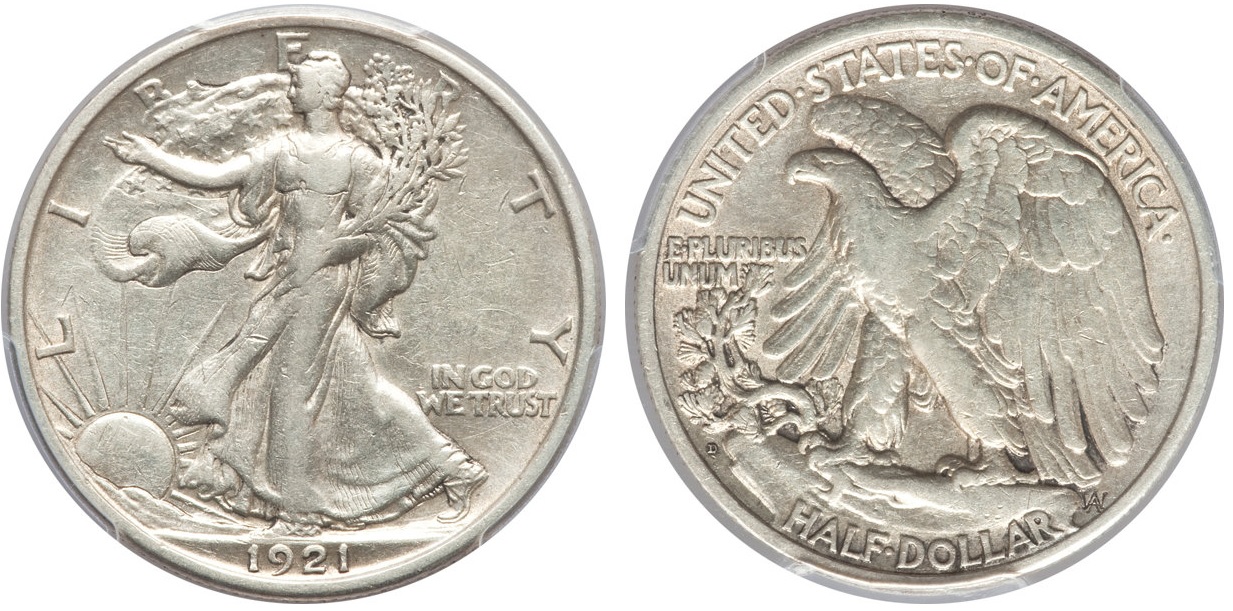
This 1812 half dollar is a tangible link to long
ago American history. Who knows, this coin may have been spent in
Baltimore as Francis Scott Key wrote "Oh say can you see...", or maybe it was in
Andrew Jackson's pocket as he fought off the British at New Orleans. The
possibilities are endless! Photo courtesy
of Ira & Larry Goldberg Coins &
Collectibles, Inc., Beverly Hills, CA. |
The Monroe Doctrine, as it came to be called,
was a direct warning to the Europeans to stay out of the Western Hemisphere.
Any incursions into North, Central, or South America would be regarded by the
American government as a hostile action against the United States, and would be
dealt with accordingly.
The issuance of the Monroe Doctrine was further
evidence of a growing tide of American strength and unity.
James Monroe served in the Continental Army under George
Washington, and was the last American president directly connected to the
Revolutionary War. Thus, before passing the mantle of leadership on to a
new generation, Monroe made clear to all that the United States was determined
to retain its hard-won independence and would forever be the master of its own
destiny. |